Custom marine hardware is hardware designed and made around one vessel’s geometry, loads, interfaces and finish rather than chosen from a catalogue, and specifying it is an engineering decision with identifiable criteria, not a matter of budget or prestige. The argument it provokes is usually accounting, not engineering. The cost of a bespoke part is visible in full, on one line of one order. The cost of forcing a standard part to fit spreads over fitting hours, programme slip and later intervention.
In short
- Custom marine hardware is justified when interface geometry, load path, sealing or drainage, or visible finish cannot be met by a catalogue part as delivered.
- Between standard and bespoke sit modified standard and semi-custom: cutting a certified part transfers the manufacturer’s responsibility to whoever made the cut.
- The cost of adapting a standard part is underestimated because it lands on fitting labour, rework and warranty work, not on the purchase price.
- Custom is the wrong choice when the design is not frozen, when an external standard governs the interface, or when the requirement cannot yet be written down.
- A quotable specification states function, datums, material and condition, tolerances only where they matter, an unambiguous finish with a sample, and documents such as EN 10204 3.1.
- Unit price falls with batch size because setup and programming are fixed per batch, and as-built documentation with lot traceability is what makes a part reproducible years later.
Standard, modified, semi-custom, bespoke: four decisions, not two
The choice is usually framed as catalogue against custom, which hides two options in between and most of the risk.
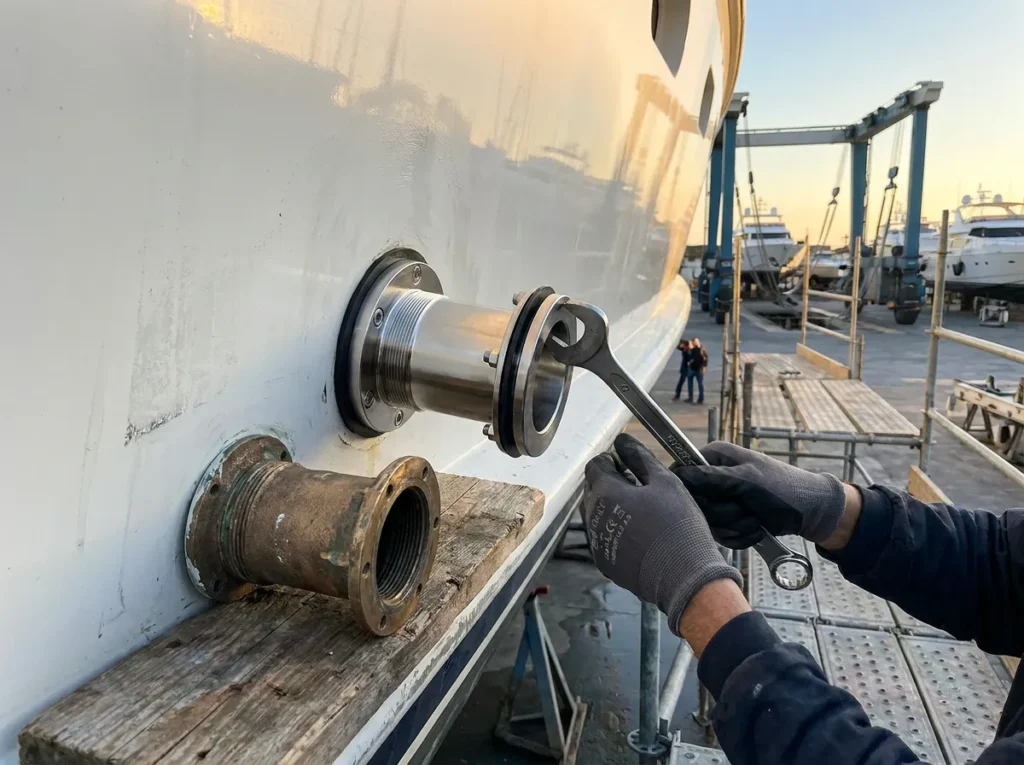
A standard part is installed as delivered, with the maker’s declaration and liability intact. A modified standard part is a catalogue item altered after purchase: shortened, re-drilled, re-welded, re-polished. At the first cut the material certificate stops describing the part, and the modifier has become its manufacturer. A semi-custom part keeps a proven geometry and a validated sealing principle while defined parameters change: bore, bolt pattern, radius, height, finish. A bespoke part is designed from the requirement.
Semi-custom is the option most often overlooked: it reuses engineering already proved on the water, which is where first-of-type risk sits.
| Criterion | Standard | Modified standard | Semi-custom | Bespoke |
|---|---|---|---|---|
| Interface | Flat, orthogonal | Minor trim | Family fits, sizes do not | Compound curvature |
| Load path | Inside rating | Unchanged | Fixing differs | Outside catalogue case |
| Sealing | Seal seat usable | Seal seat untouched | Section changes | Seal and drain designed |
| Finish | Hidden | Fully restorable | Continuity across a family | Design language |
| Quantity | Many, unchanged | One or two | A set on one vessel | One vessel or series |
| Certification | Maker’s documents | Chain broken | Reissued | From raw material |
The hidden cost of adapting a standard part
Adapting a catalogue part does not remove cost, it relocates it into accounts nobody compares with the quotation.
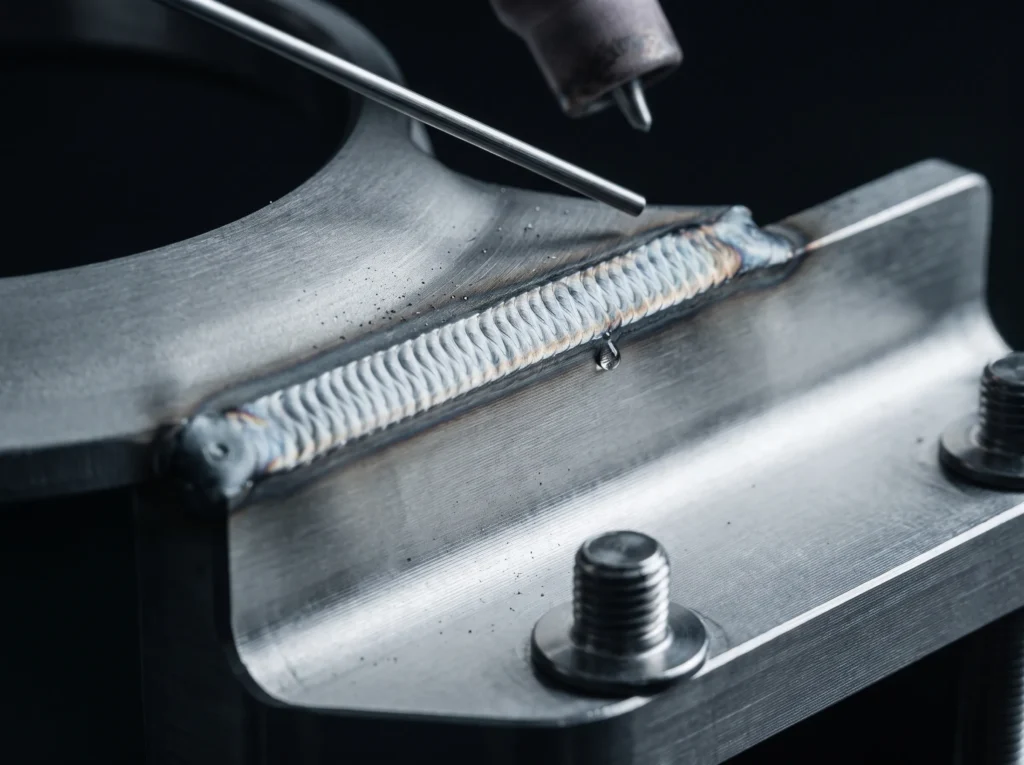
Some of it is financial: hours on a vessel already on the slipway are not priced like hours in a workshop. Some is technical, and worse. Shimming a part onto a curved surface creates a crevice, and a crevice is where stainless fails first in warm seawater, because a stagnant gap cannot sustain the passive layer. Welding or heavy grinding on an austenitic stainless leaves a heat-affected zone with different local corrosion behaviour, which is why 316L exists for welded assemblies. Bolting stainless into an aluminium 5083 structure without isolation puts two alloys far apart on the galvanic series in contact through seawater.
None of this appears on a purchase order. All of it appears later.
| Cost item | Standard part adapted on site | Purpose-made part |
|---|---|---|
| Purchase price | Low, visible | Higher, visible |
| Engineering | Absorbed by the yard | Quoted once, against a specification |
| Fitting labour | Cutting, shimming, repeated trial fits | Bolted to a defined interface |
| Sealing | Sealant compensating for geometry | Designed seal seat |
| Documentation | Chain broken at the first cut | Traceable to the marked part |
| Rework | Weeps found after launch | Failures found at first article |
| Repeats | Not reproducible | Reordered against a drawing revision |
When custom marine hardware is the wrong choice
Specifying bespoke hardware where a catalogue part would serve is a common error, paid in schedule rather than money.
Stay standard when the interface is governed by someone else’s dimension: pipe threads, hose sizes, bearing seats, fasteners, anything a crew may have to replace in a foreign port. A bespoke part there removes interchangeability and turns a routine replacement into a lead time.
Stay standard when the design is not frozen: a purpose-made part bought against a moving design converts revisions into scrap, and the change usually arrives after the material has been cut.
Stay standard when the requirement cannot be written down: a supplier cannot quote intent.
Stay standard when the part is not seen, not touched, not structural and not part of a sealing boundary. Appearance is a legitimate reason for custom; appearance on a part nobody will look at is not.
Writing a specification a workshop can quote
A specification is complete when a supplier who never met the designer can price it, make it and be judged against it without asking what was meant.
Function before geometry
State what the part seals, carries, drains, hinges or aligns, in what environment, and what happens if it fails. Function tells a supplier which dimensions matter.
Drawing, 3D model or physical sample
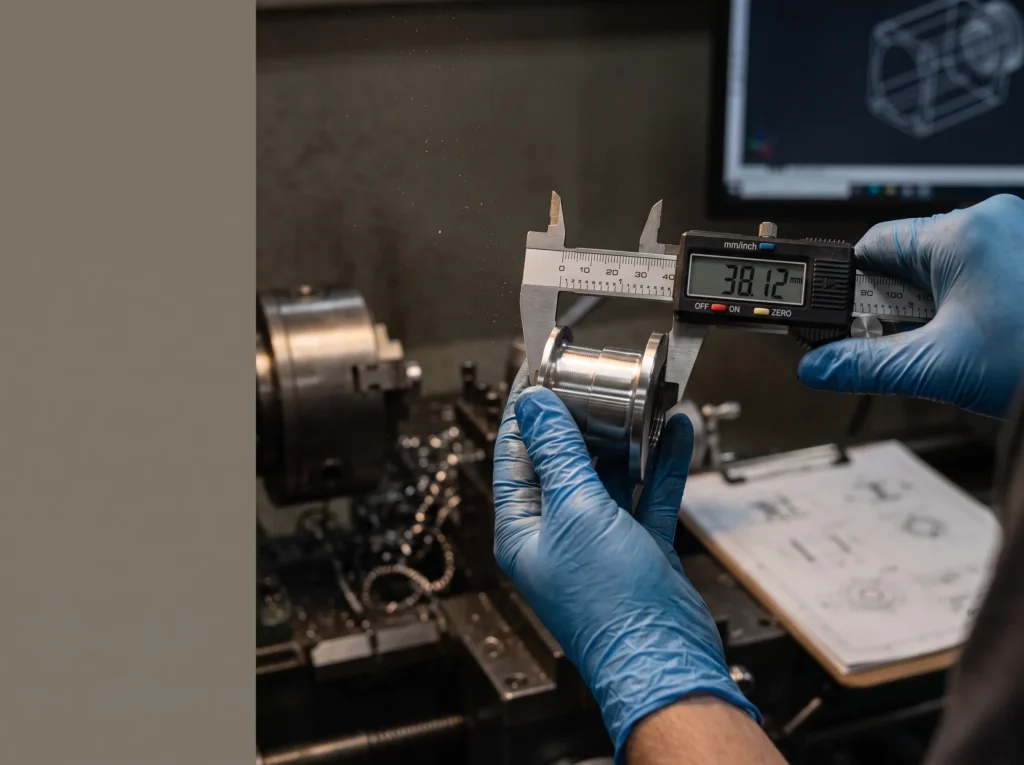
A 2D drawing carries what a model cannot: datums, tolerances, finish callouts, weld requirements, acceptance criteria. A 3D model carries geometry unambiguously and drives the toolpath. A physical sample carries everything the other two omit and nothing measurable. Use the model for geometry, the drawing for requirements, the sample only as a finish reference.
Tolerances and finish
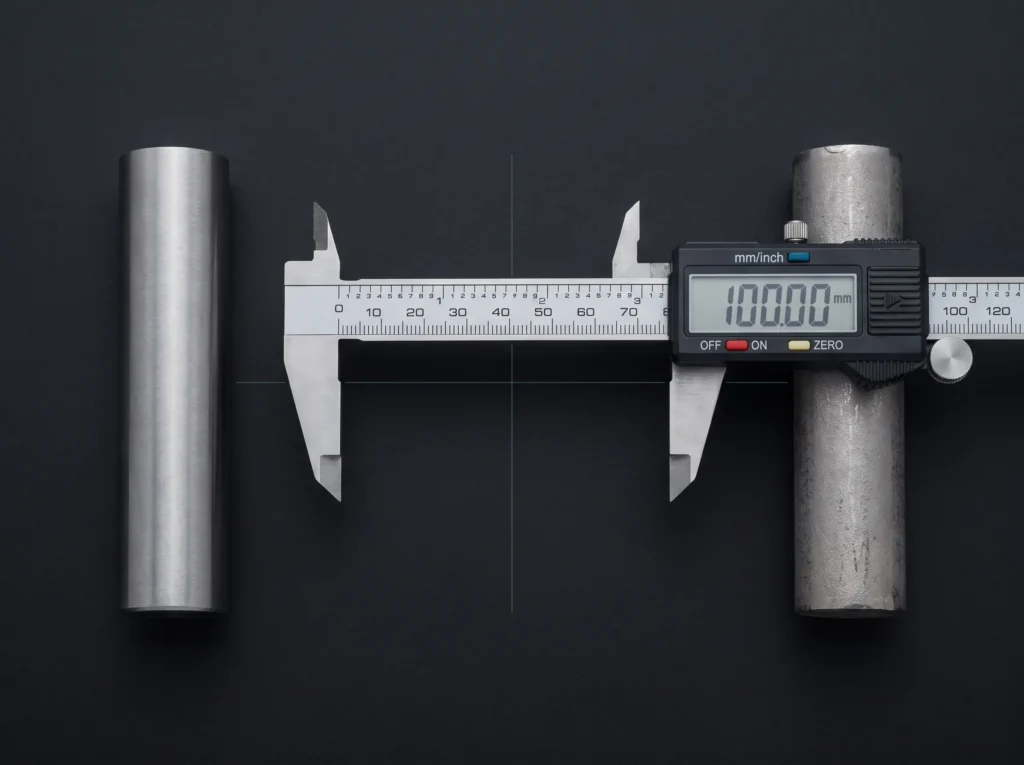
Tight tolerances on every dimension raise price without improving the part: identify the functional datum and the fits that matter, and leave the rest open. Finish is where ambiguity costs most, because satin, brushed and mirror name different results in different workshops. Define method, grain direction, where transitions are allowed, and an agreed acceptance sample. Hand finishing is paid in hours, which makes it the least compressible part of a schedule.
Material and its certificate
Name the alloy and its condition rather than a family — AISI 316 or 316L, duplex, aluminium 5083 or 6082 — and say whether equivalents are acceptable. Where traceability matters, ask for an EN 10204 3.1 inspection certificate: specific inspection results on the actual batch, validated by the manufacturer’s authorised inspection representative, independent of the manufacturing department. A 2.2 test report is not equivalent. Lloyd’s Register, ABS and DNV work from this evidence, as does the builder’s conformity file.
From first contact to first article
A custom component project has few phases, and skipping one moves the failure later, where it costs more.
It starts before the drawing, with the requirement: environment, loads, interfaces, quantity, finish, programme. A manufacturability review follows, in which the supplier says what makes the part expensive: internal radii below what a cutter can reach, deep pockets, thin walls beside welds, polishing inside re-entrant corners, springback in formed sections.
The design then freezes under revision control, with a revision number on every drawing. Changes after tooling and programming are the largest single source of schedule loss on custom work.
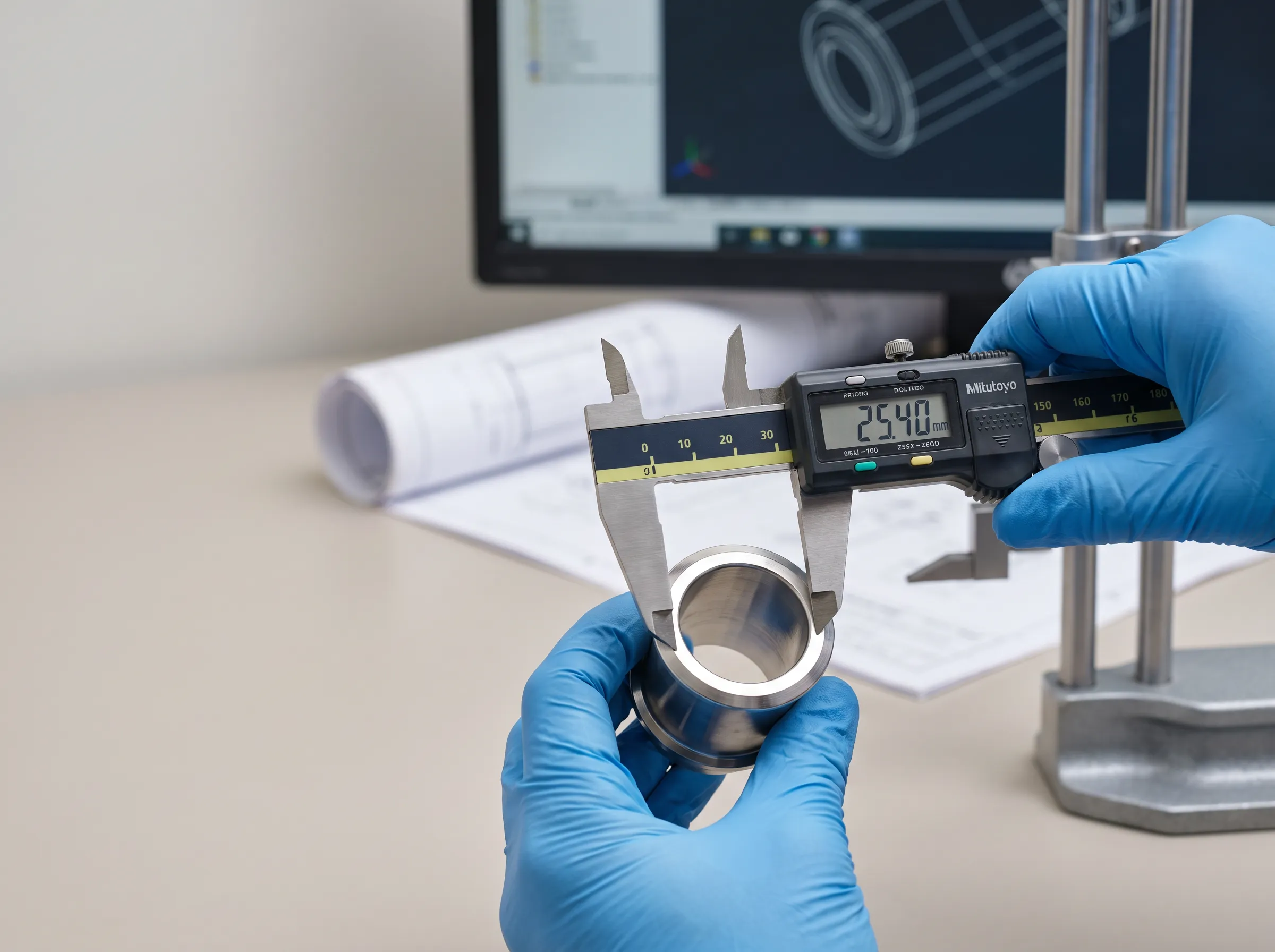
The first article is inspected against the drawing and trial-fitted on the real interface, not on a model. Where no drawing exists, as in most refit work, reverse engineering rebuilds the part, and the first decision is whether to reproduce it as worn or as intended.
The designer owns intent and appearance, the yard owns interface and installation, the supplier owns process, material and manufacturability.
How price, tooling and lead time actually form
The price of a bespoke component is a sum of identifiable items, which is what makes a quotation negotiable.
Material counts as grade and as form: machining from solid means paying for the block, not the part. Setup, fixturing and programming are fixed per batch, which is why unit price falls with quantity and why splitting one requirement into several small repeat batches costs more than ordering it once. Machining time follows geometry and how the alloy behaves under tooling. Hand finishing is paid in hours; inspection and documentation are a real line.
Break-even against a standard part is a quantity question, and it moves sharply once the standard part needs adaptation, because adaptation repeats on every unit while tooling does not.
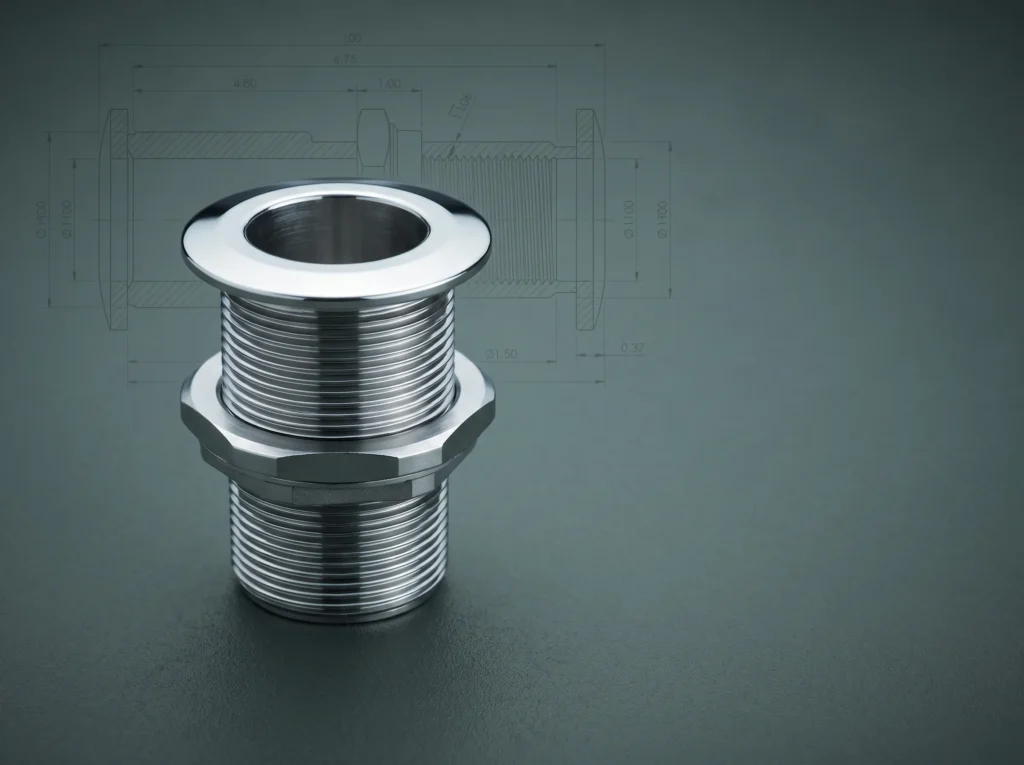
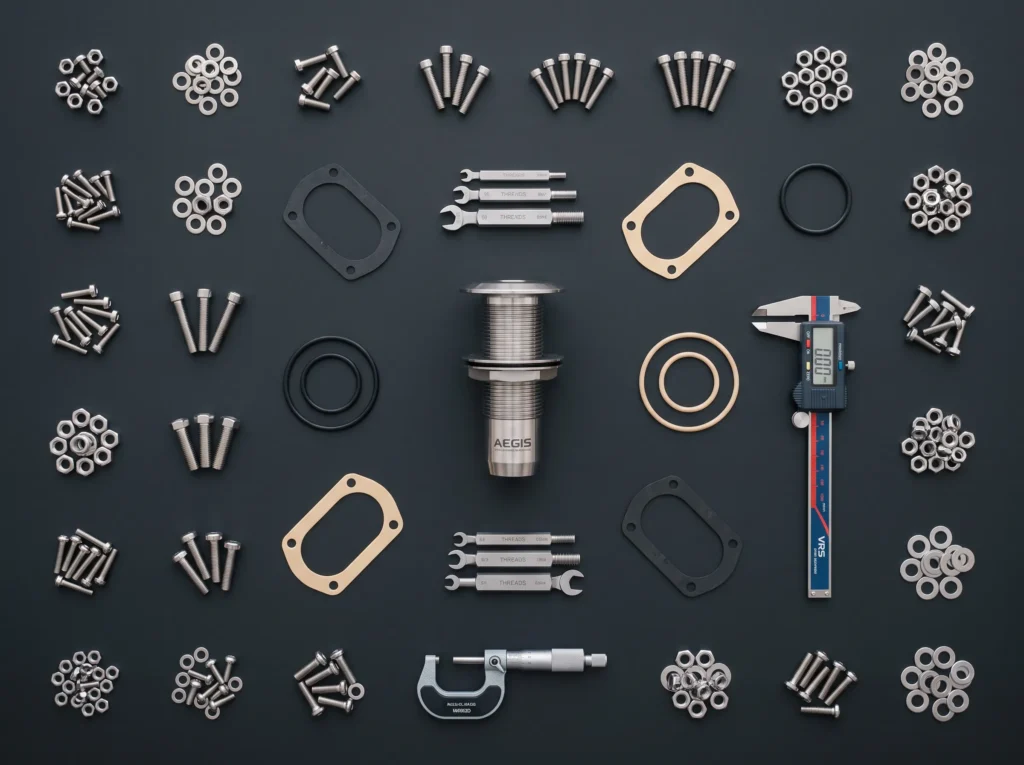
Total cost of ownership completes the picture: corrosion behaviour over a life in seawater, whether a surface can be restored in place, whether replacement means dismantling what surrounds it, and whether a spare can be reordered at all. A part machined from a single block with no welds — Aegis, a through hull fitting made this way, is one example — removes the weld as an initiation site.
Choosing the workshop, and what to ask for at handover
Capability is assessed on process control, not on a machine list. A shop with multitasking lathes, waterjet cutting and a finishing bench still has to show that it routinely works the alloy in question — 316L work-hardens, aluminium smears — and that it fixtures, inspects and finishes in a governed sequence.
Ask before issuing the specification: what is made in-house and what is subcontracted, who writes the programme, what happens to the drawing and the model, whether fixtures are kept for repeat orders, and how a non-conformity is recorded. Put ownership of design, model, CAM programme and fixtures in writing: the design normally belongs to whoever paid for it, the programme and fixtures stay with the shop.
Dual sourcing is a specification question in disguise. A second source exists only if the specification is complete enough for two workshops to produce interchangeable parts; where a part is defined by one shop’s tacit knowledge, a second supplier is a second design.
The warning signs are consistent: a quotation given without a single question, a price fixed before the finish is defined, no first article report, no traceability.
At handover, ask for as-built documentation of what was made, lot traceability tying the marked part to its certificate, and a written record of any deviation accepted and its effect on function. That is what allows the part to be remade years later.
Officine VRS has produced custom marine hardware in Viareggio, in the Italian yachting district, for over forty years. If the decision is still open, send the requirement rather than only the drawing: if a standard part will do the job, that is the answer you will get. For a quotation or the catalogue, write to info@officinevrs.com or call +39 0584 1538754.
Frequently asked questions
What is custom marine hardware?
Custom marine hardware is deck and hull hardware designed and manufactured for a specific vessel rather than selected from a catalogue, so that geometry, material, rating and finish follow that vessel’s requirement. It covers through hull fittings, scuppers, hatches, hinges and access covers.
Is custom marine hardware more expensive than standard hardware?
On purchase price, almost always. On installed cost, not reliably, because a standard part that has to be cut, shimmed, re-finished and sealed consumes fitting hours and often returns as warranty work.
When should a shipyard specify a standard fitting instead of a custom one?
When the design is not yet frozen, when an external standard such as a thread or hose size defines the interface, when spares must be available worldwide, and when the requirement cannot yet be written precisely enough to quote.
Does modifying a standard fitting void its material certification?
In practice, yes. A material certificate describes the part as manufactured, so cutting, welding, re-drilling or re-finishing means the delivered part is no longer the certified part. Responsibility passes to whoever performed the modification, which matters when a classification society asks for evidence.
What is an EN 10204 3.1 certificate and when should it be requested?
An EN 10204 3.1 inspection certificate reports specific inspection results for the actual material batch, validated by the manufacturer’s authorised inspection representative, who is independent of the manufacturing department. Request it whenever a component is structural, part of a sealing boundary, or subject to class documentation.
How is the price of a bespoke marine fitting calculated?
From material grade and form, setup and fixturing, programming, machining time driven by geometry and alloy behaviour, hand finishing, inspection and documentation. Setup and programming are fixed per batch, so unit price falls as quantity rises.