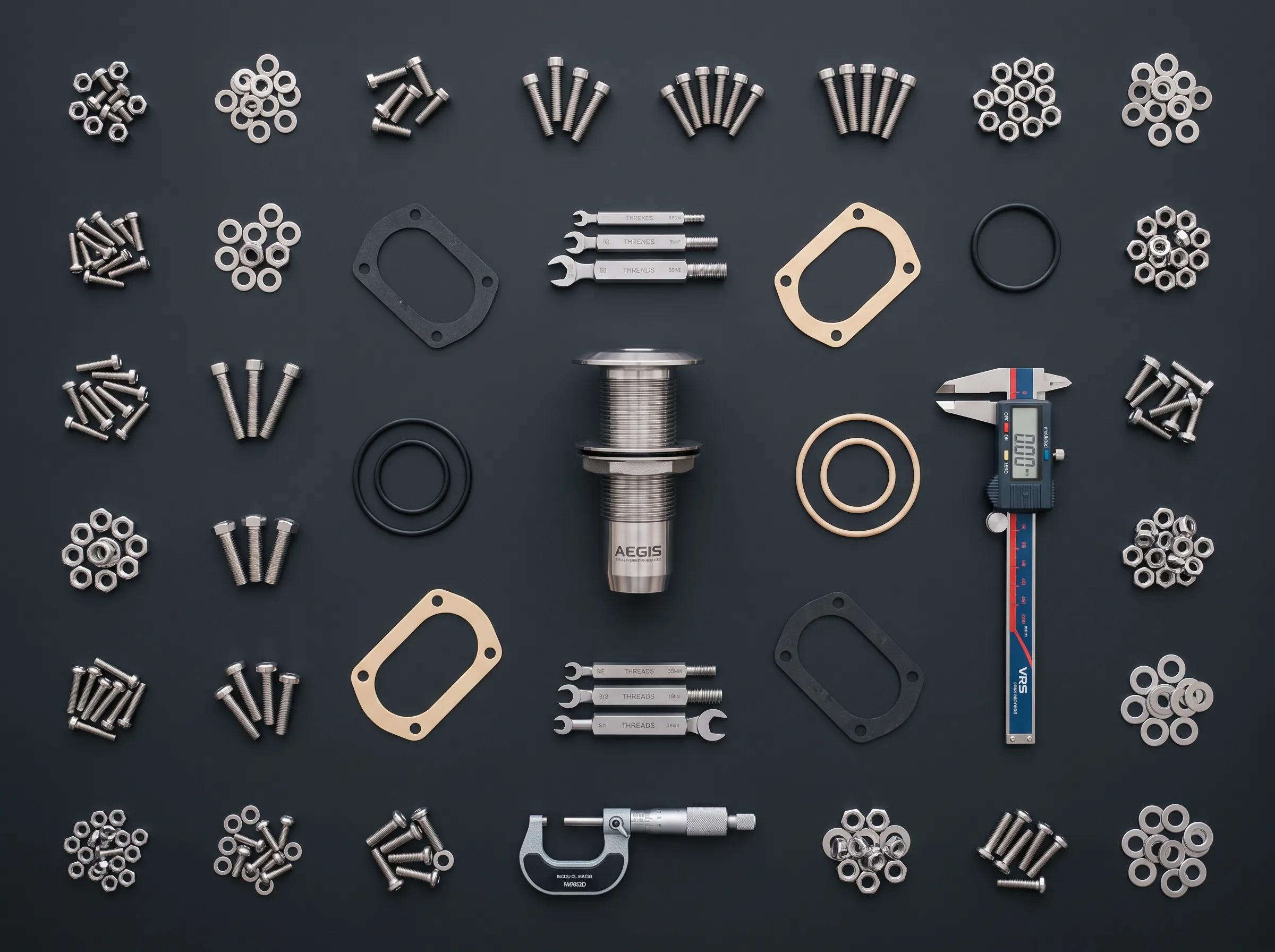
Precision marine hardware manufacturing is the controlled sequence that turns a certified metal blank into a fitting able to survive permanent exposure to salt water. Its outcome rests on three decisions the specifier rarely sees: the alloy, the machining strategy and the surface treatment. Each affects corrosion behaviour as much as the grade printed on the certificate. An AISI 316 fitting machined and finished badly fails sooner than an AISI 316 fitting machined and finished well.
In short
- Precision marine hardware manufacturing rests on three decisions the specifier rarely sees: the alloy, the way material is removed or joined, and how the surface is finished.
- A material certificate states a starting condition, not a performance: identical AISI 316 stock reaches the boat with very different corrosion resistance depending on processing.
- Machining from solid keeps the grain structure continuous and removes the weld seams, filler metal and casting porosity where crevice and pitting corrosion usually begin.
- Every weld creates a heat affected zone that behaves differently from the parent metal unless grade choice, cleaning and passivation compensate for it.
- Surface roughness is a corrosion variable: tool marks and embedded abrasive retain chlorides, which is why electropolishing and passivation change service life.
- Dimensional inspection proves geometry only; metallurgy, surface condition and joint integrity need separate evidence, such as dye penetrant testing and an EN 10204 3.1 certificate.
The three decisions that govern precision marine hardware manufacturing
A finished fitting shows nothing of its own history: two components can leave two workshops with the same designation on paper and behave differently after three seasons.
The first decision is the alloy, chosen for what it allows the designer to draw as much as for how it resists seawater. The second is how the part comes into existence — cut from solid, cast, or fabricated and welded — because that fixes where the discontinuities will be, and discontinuities are where corrosion starts. The third is the surface, and whether the passive chromium oxide layer was restored after machining stripped it.
None of the three appears in a render. All three appear after a few winters in the Mediterranean.
Alloy selection is a manufacturing constraint, not only a material choice
The alloy shapes the part as much as the environment does: machinability, weldability and springback are properties of the material, and a drawing that ignores them produces a component that is expensive or unstable.
Stainless grades
The distance between AISI 304 and AISI 316 is molybdenum, and in chloride environments that is not cosmetic: molybdenum raises resistance to pitting, the failure mode that matters on a boat. Specifying 304 for a permanently wet fitting is not a budget decision, it is a shorter design life.
The distance between 316 and 316L is carbon. Standard 316 carries enough of it that, in the sensitisation range — indicatively 450 to 850 °C, the band a weld zone passes through as it cools — chromium carbides can precipitate at the grain boundaries and locally strip the surrounding metal of the chromium it needs to stay passive. The result is intergranular attack beside a weld that looks perfect. The low-carbon L grades largely remove the mechanism, which is why 316L is the starting point for anything welded.
Free-machining variants carry a warning: the additions that improve chip control also act as pitting initiation sites.
Aluminium and duplex
Aluminium 5083 is the marine-structural default because it resists seawater well, welds predictably and does not rely on heat treatment for strength; it is also gummy to machine. Aluminium 6082 cuts more cleanly and is stronger once heat treated, but behaves differently in permanent immersion.
Duplex stainless offers higher strength and better resistance to chloride stress corrosion cracking, which is why it appears in highly loaded wet fittings. It also cuts slowly, wears tooling, and demands controlled heat input so the phase balance survives welding.
Billet, casting or assembly: how the part comes into existence
How a component is brought into being determines where its weak points are: in marine hardware, almost always joints, pores and sharp internal corners.
| Criterion | Machined from solid | Cast | Fabricated and welded |
|---|---|---|---|
| Material continuity | One certified blank, no joints or filler | Solidification structure, possible porosity | Parent metal interrupted at every seam |
| Where failure begins | Unblended internal corners, tool marks | Subsurface porosity | Heat affected zones and weld toes |
| Traceability | One heat number for the whole part | Pour by pour, foundry dependent | One certificate per section, plus filler |
| Cost logic | Removed material is paid for; flat unit cost | Tooling front-loaded, falls with volume | Labour-driven, scales poorly |
| Natural fit | Sealing parts, small series | Repeating shapes in volume | Large frames and structures |
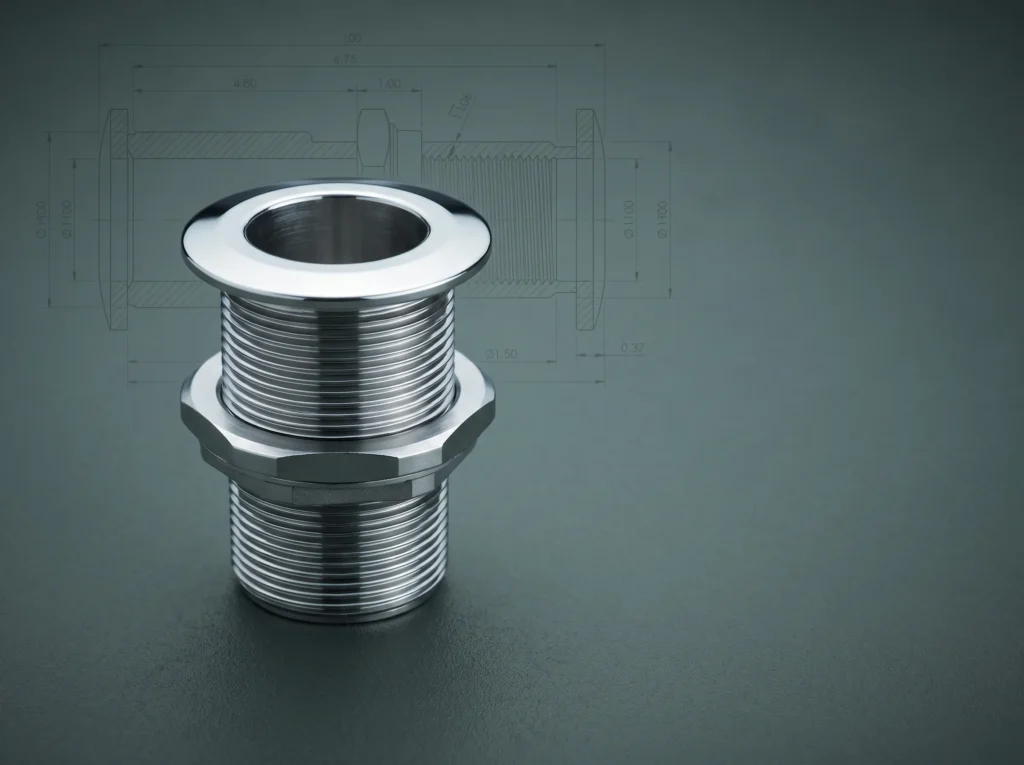
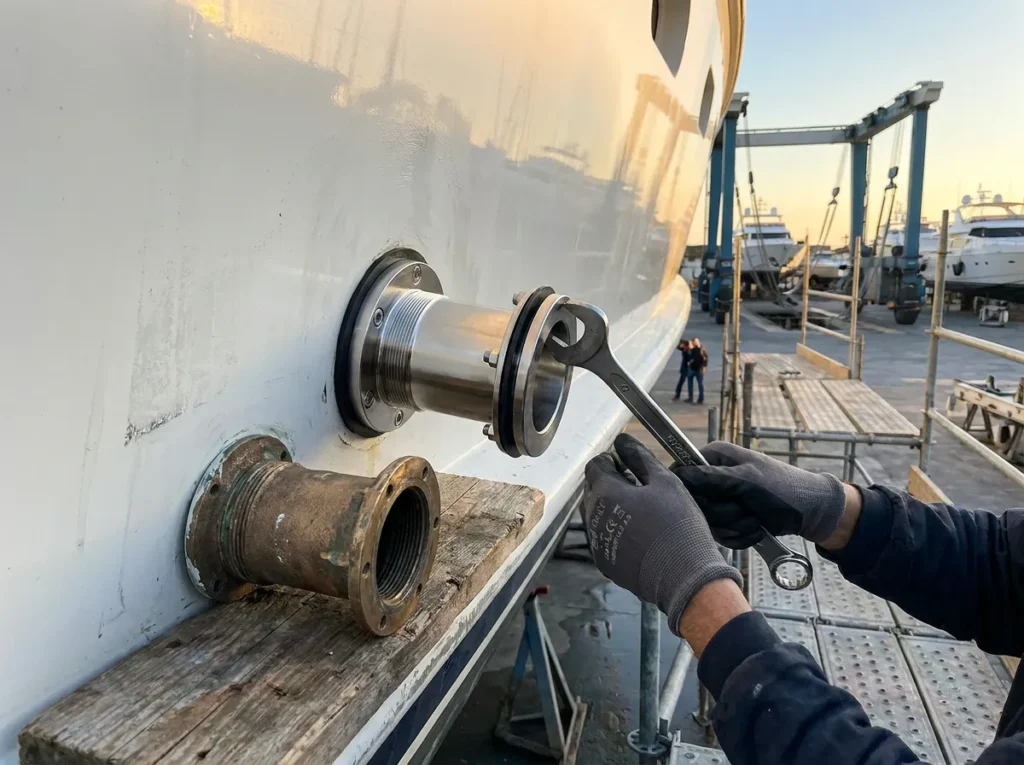
This is the reasoning behind a through hull fitting such as Aegis, machined from a single block with no weld seam in the sealing path: removing the joints removes the most probable place for failure to start.
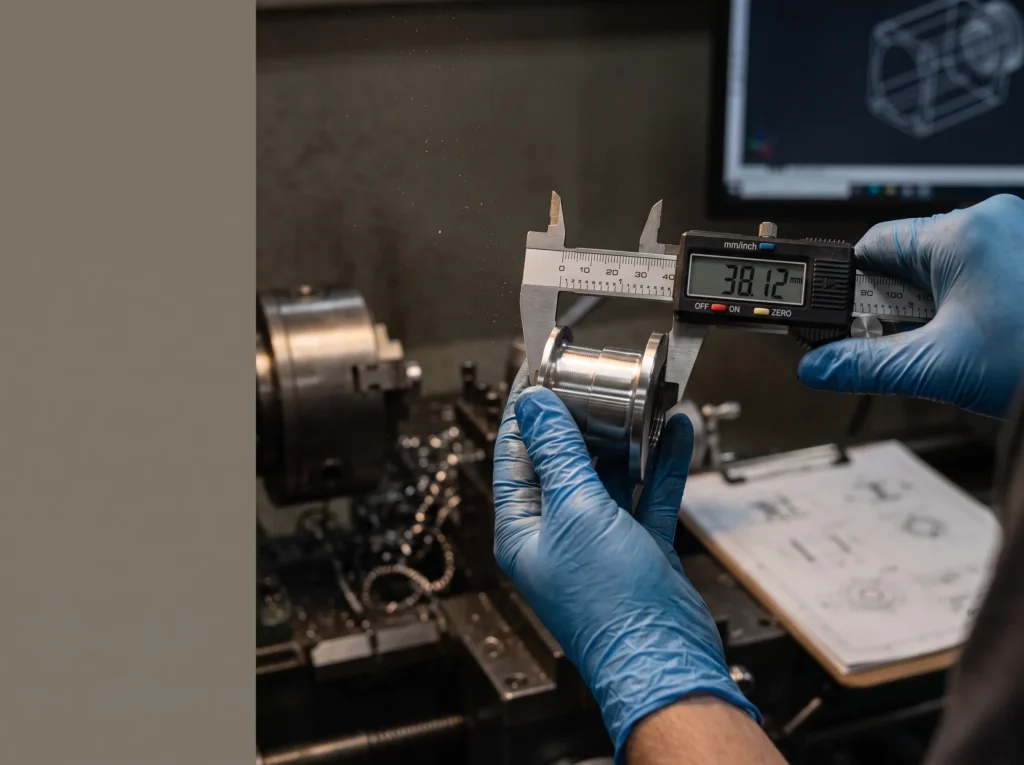
Two process choices carry most of the quality in small-series work. A multitasking lathe that turns, mills and drills in one setup holds concentricity through the machine’s own geometry rather than through repositioning: every setup removed is a stack of errors removed with it. Abrasive waterjet cutting produces profiles without heat, so the cut edge carries no altered structure to grind away. Five-axis milling earns its place when the surface is not developable and the tool must stay short and normal to the face.
Welding: the most useful process and the most demanding one
TIG welding is the correct process for many marine stainless assemblies, and also the operation that most reliably degrades the corrosion resistance of the metal around it. Good manufacturing means deciding which of those two statements governs a given part.
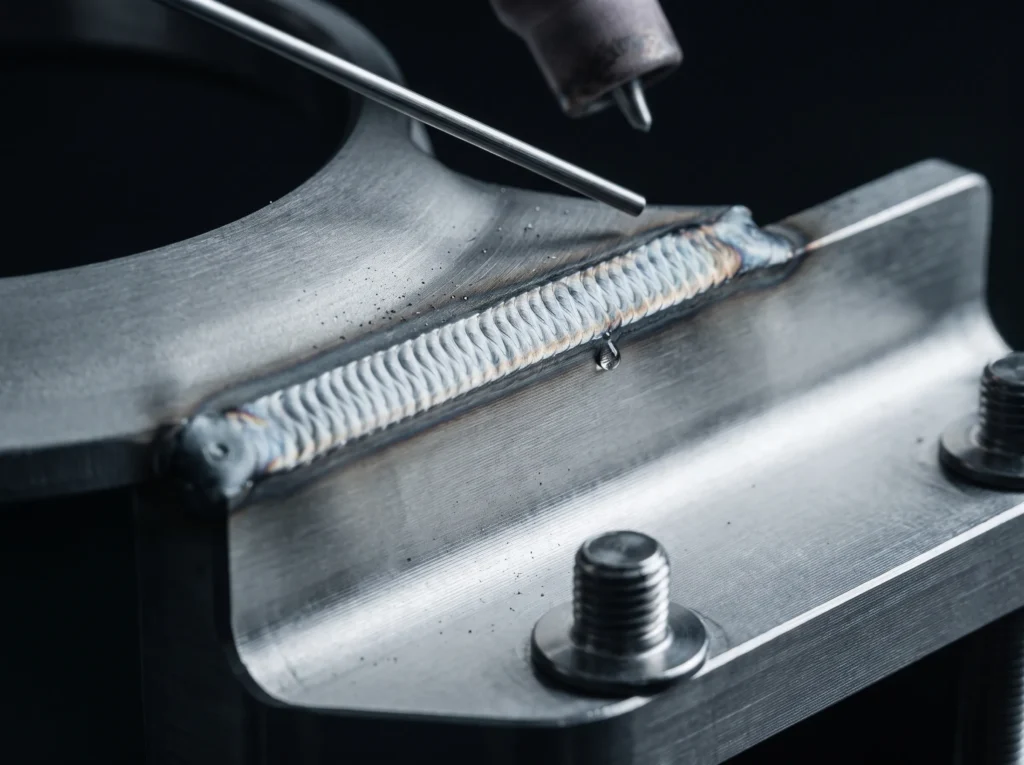
The heat affected zone is the band of parent metal that never melted but was heated enough to change. It is where sensitisation can occur, where the passive layer is destroyed and replaced by heat tint, and where residual stress concentrates. Heat tint is not cosmetic: the oxide scale is chromium-depleted underneath, and unless it is removed by pickling or mechanical cleaning and the surface then passivated, the weld area corrodes first — usually where it can be seen.
That is why the interface between a welded assembly and a machined one must be designed. A gas welded sleeve such as Argos gives a yard a connection that takes welding heat without compromising the precision feature behind it: tolerance-critical geometry must sit far enough from the arc to survive it.
Where a joint can be mechanical instead of welded, it usually should be: a bolted connection can be inspected and replaced, a weld can only be cut out. The trade is galling — adhesive seizure of similar stainless surfaces under load — managed by pairing dissimilar hardnesses, using anti-seize and assembling slowly.
Surface finish is a corrosion variable
Finish is usually specified as an appearance. It is more accurately a description of roughness, cleanliness and surface chemistry, and all three influence how long the part resists attack.
Rough surfaces corrode sooner than smooth ones of the same alloy. Peaks and valleys retain salt after rinsing and create micro-crevices where the local chemistry turns more aggressive than the surrounding water. Machining also leaves foreign matter: free iron from tooling, embedded abrasive, and smeared metal that covers the passive layer instead of repairing it.
| Finish | Visual effect | Effect on corrosion resistance | Maintenance |
|---|---|---|---|
| As-machined | Directional tool marks, matt | Poorest: retains chlorides and contamination | Unsuitable for exposed surfaces |
| Brushed / satin | Uniform directional grain | Improves with finer grit; grain lines hold deposits | Wipe along the grain; repairable locally |
| Mirror polished | Specular, conceals nothing | Helped by low roughness, harmed by polishing residue | Highest: shows spotting and marks |
| Electropolished | Bright, softer than a mechanical mirror | Best: peaks dissolved, surface enriched in chromium | Low; deposits release easily |
| Bead blasted | Uniform matt, non-directional | Depends on the medium: iron-bearing media contaminate | Moderate; hides scratches, holds salt |
| Passivation | None | Restores the chromium oxide layer after machining | A process step, not a finish |
Passivation is the step that disappears from most specifications. It adds no coating: it removes free iron and lets the chromium oxide film reform evenly. On a part that has been turned, milled, deburred and handled that film is damaged almost everywhere, and skipping the step lets rust appear on genuine stainless within a season.
The corollary is consistency. Parts made months apart, on different machines and by different hands, will not match unless grit sequence, direction and final treatment are specified and recorded.
Proving the part: what inspection can and cannot show
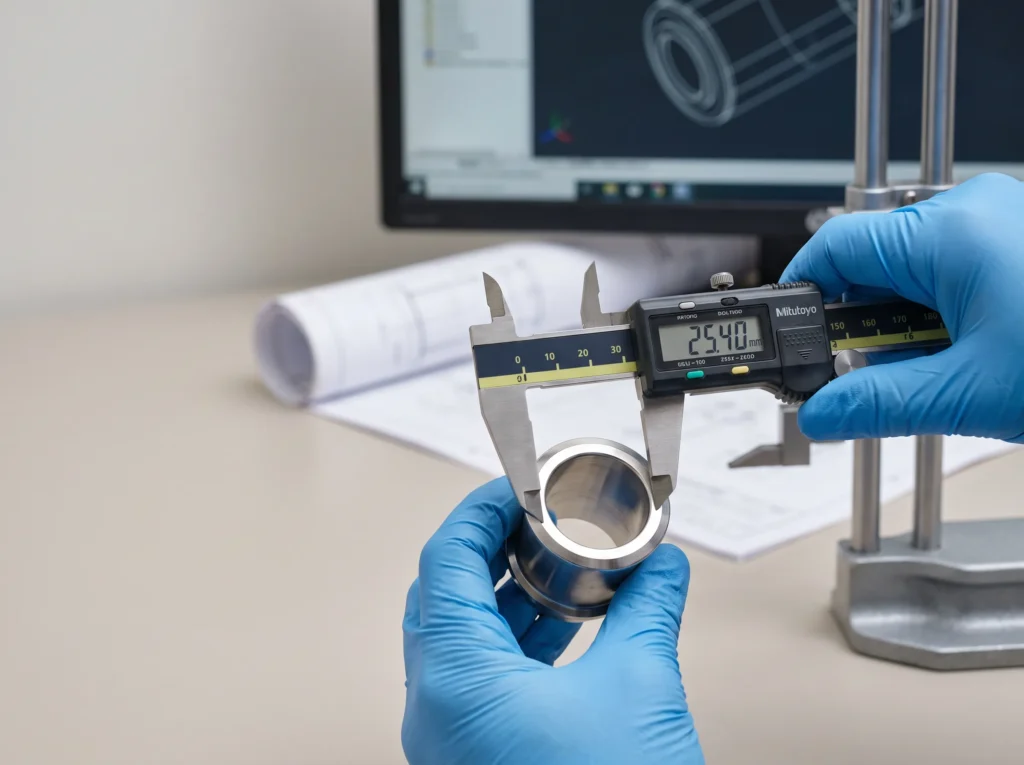
Dimensional inspection demonstrates that geometry falls within drawing tolerance, and nothing else. It says nothing about the metallurgical state of a weld, residual stress, surface contamination, or whether the passive layer was restored. Indicative tolerances in this kind of work sit in the hundredths of a millimetre and tighter on sealing features — but the correct figure is the one the application requires.
The rest of the evidence comes from elsewhere. An EN 10204 3.1 certificate ties the part to a specific heat of material. Dye penetrant testing finds surface-breaking defects, and it is the relevant method on austenitic stainless because magnetic particle inspection does not work on a non-magnetic structure. Radiography or ultrasonic testing addresses the volume of a weld. A first article — one complete part, fully inspected before the batch proceeds — turns a hopeful process into a controlled one.
Kinematics, real loads and parts that no longer exist
Not every component is judged on corrosion. A pantograph hinge such as Chiron is judged on motion: it must carry a heavy panel along a path that keeps it clear of surrounding surfaces, hold that path without slack after thousands of cycles in an environment that attacks the pivots. Its manufacturing problem is tolerance accumulating across linked pivot centres — the case where single-setup machining repays itself, because the geometry between pivots stays as drawn.
Sizing it on real loads rather than the static weight of the panel is the other half of the work: dynamic loading in a seaway, off-axis loading when a panel is opened under heel, and wear that changes clearances over years.
The same capabilities answer a different question that reaches a workshop in Viareggio, in the Italian yachting district, constantly: a fitting on an older yacht has failed, the original supplier is gone, and there is no drawing. The route is reverse engineering from the surviving part, a decision on which original compromises to keep and which to correct, and a first article fitted before a set is made.
Frequently asked questions
What is the difference between 316 and 316L stainless steel?
316L is a low-carbon version of AISI 316. The lower carbon limits chromium carbide precipitation at grain boundaries when the metal passes through the sensitisation range, which is what a weld does. For welded parts, 316L is the safer specification.
Is a fitting machined from solid really better than a cast or welded one?
For sealing and pressure-bearing marine fittings, generally yes, because it has no joints: no filler metal, no heat affected zone, no casting porosity. For large structures or repeating shapes in volume, casting and fabrication remain rational.
Does welding reduce the corrosion resistance of stainless steel?
Locally, yes, unless it is managed. The heat affected zone loses its passive layer and gains heat tint that is chromium-depleted underneath. Removing that oxide by pickling or mechanical cleaning and then passivating restores most of the lost resistance.
Does polishing stainless steel make it more corrosion resistant?
Smoother generally means more resistant, because there are fewer grooves to trap chlorides. But mechanical polishing leaves abrasive particles behind, so a mirror finish only helps if it is cleaned and passivated afterwards.
Is passivation always necessary?
On any stainless part that has been machined, ground or handled, it is close to essential. Passivation removes free iron picked up from tooling and lets the chromium oxide film reform evenly. Skipping it is why genuine AISI 316 can rust in its first season.
Why do stainless steel bolts and threads seize?
Austenitic stainless galls: under load, two similar surfaces sliding against each other adhere, tear and seize. The remedies are dissimilar hardnesses, a suitable anti-seize compound, clean threads and slow assembly. Tightening harder makes it worse.