Yacht hardware design integration is the set of decisions that determine whether a metal component reads as an object placed on a surface or as part of the surface itself. It is settled early, in how a deck is laid out and a substrate specified. Hiding a component is not a styling gesture: it moves tolerance from the part to the assembly, and changes drainage, access and how the detail ages.
In short
- Yacht hardware design integration decides how much of a metal component the eye may see, and what the surrounding surface must do to allow it.
- A flush component moves tolerance from the part to the assembly: deck, substrate and build sequence must be as accurate as the part.
- The reveal around it is a drawn dimension, and it matters more that it stays constant than that it is narrow.
- Concealment becomes an error when it blocks inspection, closes a maintenance path, or hides something that must be found fast in an emergency.
- A flush hatch still needs drainage: removing the visible rebate only moves the water into a gutter that must be drawn, drained and kept clear.
- Stainless steel AISI 316, aluminium 5083 and bronze differ in colour temperature, reflectivity and galvanic potential, so a mixed palette is also an electrochemical decision.
- Invisibility is cheapest at concept stage; once structure and substrates are frozen it is bought back with rework.
Why yacht hardware design integration decides perceived quality
On board, metal is the only material that is structural, tactile and reflective at once. Timber can be beautiful and passive; a metal component is always doing something, and it does so in full view, where the light falls hardest.
Perceived quality concentrates there. Nobody evaluates a laminate schedule: they put a hand on a handle, step on a hatch, and read the line where two surfaces meet. The eye catches a line that is not parallel or a gap that widens, but cannot judge whether that gap is narrow in absolute terms. Consistency, not tightness, reads as quality — and a detail resolved once and repeated across a whole boat is one of the few things a studio holds intact to delivery.
Visible, discreet, invisible: three strategies, three costs
Invisibility is not automatically the higher ambition. It is one of three legitimate positions, each with a different technical burden.
| Strategy | Design cost | Technical risk | When it is right |
|---|---|---|---|
| Visible | High on the object: it must survive inspection from every angle | Low — tolerances stay inside the component | Safety-critical items, anything handled often, details giving scale |
| Discreet | Medium — needs a coherent finish and a controlled surround | Medium — the surround joins the detail, so substrate quality matters | Most deck and interior hardware, where function stays legible |
| Invisible | High — constrains structure, substrate, build sequence and access | High — every assembly tolerance surfaces in one visible line | Continuous surfaces, primary sightlines, anything below the waterline |
As visibility drops, cost migrates from the component to everything around it. A visible fitting is expensive to make well; an invisible one is cheap to make and expensive to install, because the yard must hold a surface, not just a part.
Integrating flush: the deck as a continuous surface
The reveal is a drawn dimension
The reveal is the visible gap between a flush part and the surface it sits in. It absorbs thermal movement, substrate movement and assembly tolerance while staying constant. On high-end work the target is usually stated in tenths of a millimetre rather than millimetres, but any figure is indicative and belongs to a specific assembly. Two reveals of different widths on one deck damage the design more than a single generous one: the question is not only how narrow, but how repeatable.
Flatness, not just fit
A part can be perfectly machined and still sit proud. Flush is a property of the assembly: aperture flatness, the stiffness of the structure beneath, the thickness tolerance of the covering, and whether the component goes in before or after the deck is laid. Underfoot a step is felt before it is seen — a lip of a fraction of a millimetre catches a bare foot, or collects dirt on one edge only. Components such as Eirion, the flush deck step and hatch, close this at the component end; the aperture still has to be prepared for them.
Flush and watertight at the same time
Removing the visible rebate does not remove the requirement. It relocates the seal below the visible plane and makes drainage a drawn feature: a recessed gutter with a clear drain path, sized for the water the surface collects and reachable for cleaning. Openings are also regulated — ISO 12216 covers windows, portlights, hatches and doors, and societies such as Lloyd’s Register, ABS and DNV set requirements for the vessels they class. Concealment and sealing therefore belong in the same conversation.
Hardware you are not meant to see
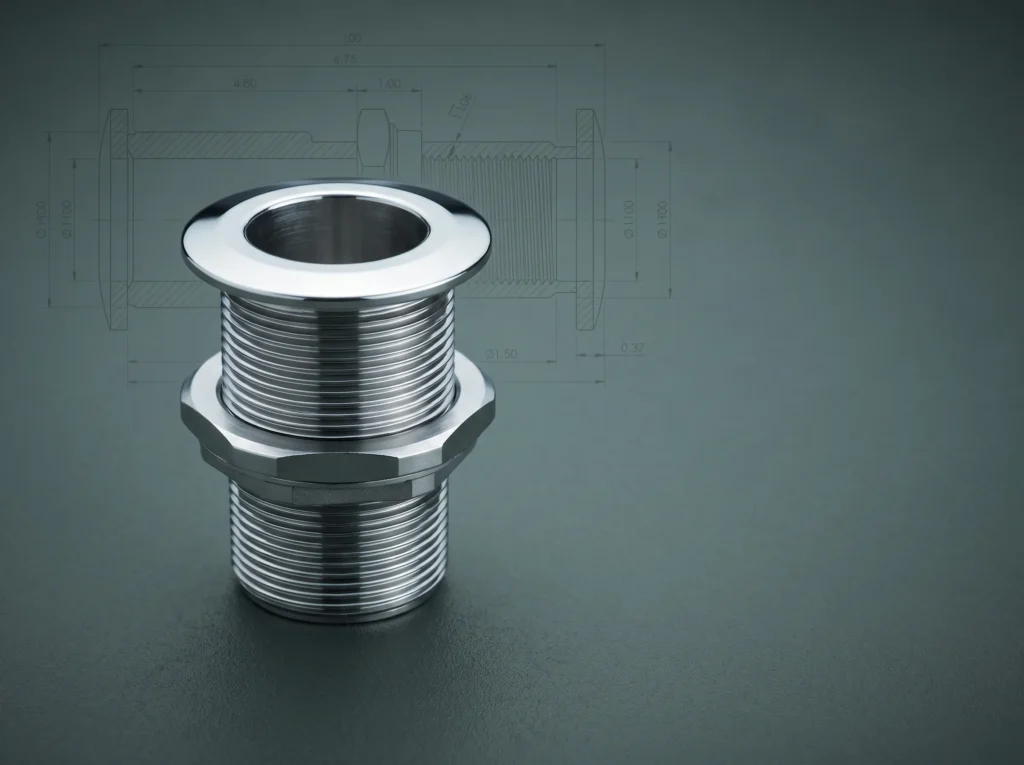
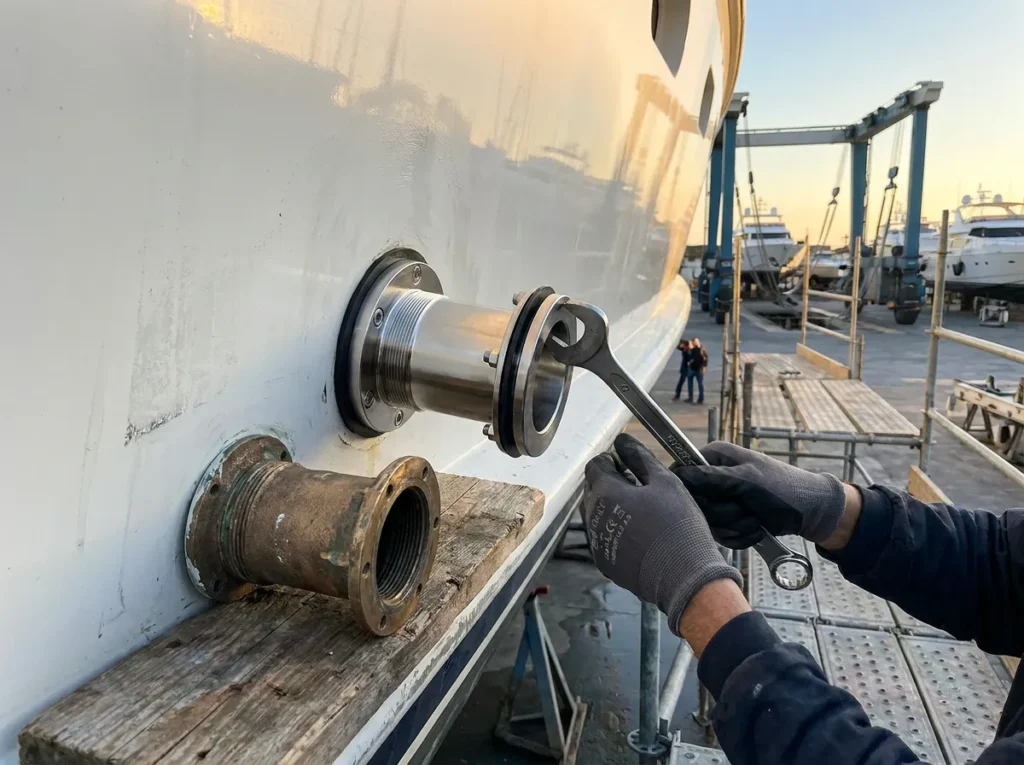
Below the waterline the case for invisibility stops being aesthetic. A protrusion is drag; a cavity is a place for fouling and crevice corrosion. Aegis, the through hull fitting machined from a single block without welds, shows the principle: removing welded joints removes the geometry where crevice attack prefers to start, and lets the fitting be faired into the hull rather than applied to it. Nobody photographs a through hull; it is detailed anyway, because a shape that sits cleanly in the flow is also one that can be inspected and replaced.
A hinge is the most visible admission that a surface opens. Concealing it means choosing a kinematic that carries the leaf away from the aperture instead of swinging it about an exposed pin — the logic of a pantograph hinge such as Chiron. The trade is space: the mechanism leaves the eye but not the structure, and needs a volume reserved early, before joinery and systems claim it.
The most common failure of an invisible detail is not visual: it is that nobody can service it. Two questions settle this at drawing stage. How is the part removed, and does that path still exist once the interior is finished? Can the seal and the drain be inspected without breaking a finished surface? If the answer is no, visibility was the right strategy and it was traded away too cheaply.
Material coherence: one metal palette for the whole boat
A yacht rarely uses one metal. Stainless steel AISI 316 and 316L, aluminium 5083 and 6082, and bronze each have a different colour temperature, reflectivity and way of ageing. Placed side by side without intent, they read as a procurement history rather than a design.
The tool is a project palette: a short written list of the metals allowed on board, each with its specified finish and each assigned a role — exterior structural, exterior touched, interior visible, interior concealed. It works only if it is maintained through construction, because parts made at different moments drift apart in finish long before they drift apart in dimension. It also carries an electrochemical constraint: contact between dissimilar metals in seawater drives galvanic corrosion, so every junction needs isolation or a deliberate separation.
Finish behaves differently under different onboard light, which is why a sample approved in a studio can disappoint on board.
| Finish | Direct sunlight on deck | Warm interior lighting | Grazing or cove lighting |
|---|---|---|---|
| Mirror polish | Very high glare; reflects sky and surroundings, so shape is hard to read | Deep and dark, taking the colour of nearby materials | Every waviness is exposed |
| Satin / brushed | Controlled directional highlight; grain direction becomes a design decision | Soft and consistent, reads as matt metal | Grain shows strongly; mismatched direction is obvious |
| Bead-blasted / matt | Low glare, uniform grey; shape reads clearly | Can look flat and lose its metallic character | Texture hides minor irregularity |
| Electropolished | Bright but smoother than mirror | Clean and neutral | Reveals form gently |
Boundaries need the same care: wood moves and metal does not, so that joint is a designed gap, and against leather or fabric the edge radius decides whether the detail abrades it.
The detail you touch
Ergonomics is where an invisible detail either earns its choice or reveals it as a compromise. Perceived weight matters — a handle machined from solid feels different from a formed one, and the difference registers before any conscious judgement. So does sound: the closing note of a latch is a designed property of mass, clearance and damping. Under way the test is stricter, because deck hardware is worked one-handed, often wet or cold. A flush pull that needs two fingers and good balance in a marina can be unusable at sea.
Ageing is the last ergonomic question. Some details age into patina — bronze shifts colour predictably. Others degrade: a bright finish gone uneven, a gap filled with sealant residue, a satin surface burnished to a shine where hands always land. Deciding which surfaces will be worn by use, and specifying them so the wear looks intentional, is part of the detail.
Working with the workshop
Design intent has to become a specification before it can become a part. A drawing that says “flush” leaves the most expensive decisions open: flush to what datum, with what reveal, with what allowance for substrate movement. The studio states what the eye must see; the workshop states what metal can hold at that size, in that alloy, with that finish.
Timing has the steepest cost curve: at concept stage concealment costs drawing time, while once structure, substrates and systems routing are frozen the same intention has to be recovered through rework.
Mock-ups close the gap renders cannot: a render will not show how a satin grain behaves under a cove light, how a reveal reads at a shallow angle, or how a handle feels in the hand. This is the working method of the Viareggio yards and the Italian marine district around them, where drawing offices, joinery shops and metalworking workshops sit close enough to settle a detail on the bench. Officine VRS works in that context, with over forty years of custom marine hardware for yacht and superyacht builders.
Frequently asked questions
What does “flush” actually mean for yacht deck hardware?
Flush means the component’s visible face sits in the same plane as the surface around it, separated only by a controlled reveal. It is a property of the finished assembly, not of the part alone: aperture, substrate thickness and the structure underneath decide it.
Is concealed hardware more expensive than visible hardware?
Usually yes, but the cost appears elsewhere: the part can be simpler, while the expense sits in the surrounding structure, the tolerances the yard must hold and the volume reserved for a mechanism. Decided at concept stage the premium is drawing time, decided late it is rework.
How tight should the gap around a flush hatch be?
There is no universal figure. The reveal has to absorb thermal movement, substrate movement and assembly tolerance, so it is agreed between design studio and workshop for each family of openings. What matters more than absolute width is that it stays uniform along the perimeter.
Can a flush hatch be genuinely watertight?
Yes, provided the seal sits below the visible plane and the water has a drainage route. A recessed gutter with a clear, accessible drain path makes a flush opening survivable in service. Openings are also covered by ISO 12216 and by societies such as Lloyd’s Register, ABS and DNV.
Which metals can be combined in the same yacht interior?
Stainless steel, aluminium and bronze can coexist, on two fronts. Visually they differ in colour temperature and reflectivity, so they need distinct roles rather than random mixing. Electrically, contact between dissimilar metals in seawater drives galvanic corrosion, so junctions need isolation.
When should the metalwork workshop be involved in a yacht design?
While the geometry is still soft, before structure, substrates and systems routing are frozen. That is when a reveal, a reserved volume or an access path can still be created by drawing rather than rework. Late involvement changes not what is possible, only what it costs.