Knowing when to use custom marine parts is an engineering judgement, not a matter of prestige: the catalogue item stops being the rational choice when the geometry, the material interface, the rating, the surface detail or the availability of the part no longer match the project. Five situations cover nearly every case, and each can be recognised on the drawing before anything is ordered.
In short
- Custom marine hardware becomes the rational choice in five situations: geometry outside the catalogue, a transition between two materials, a requirement above the published rating, a flush detail, and an obsolete part on a boat still in service.
- The reliable signal is displacement: when the problem leaves the component and enters the structure or the paperwork around it, the standard part has stopped solving it.
- Standard hardware stays correct when the mounting face is flat and nominal, one material family is involved, the rating covers the position on board, and the fitting may stay visible.
- Cost does not disappear with a catalogue purchase; it moves to fitting labour, rework and documentation at survey.
When to use custom marine parts: the test that comes first
One test settles most of these decisions: after the proposed adaptation, where does the problem live? If it stays inside the component, the catalogue item is doing its job. If it moves into the surrounding structure, the finish or a note reading “to be verified on board”, the adaptation has relocated the problem rather than solved it.
The five situations
| Situation | Signal at design stage | Consequence of forcing the standard |
|---|---|---|
| Geometry outside the catalogue | Packers or filler under the flange | Two sealing interfaces where one was designed |
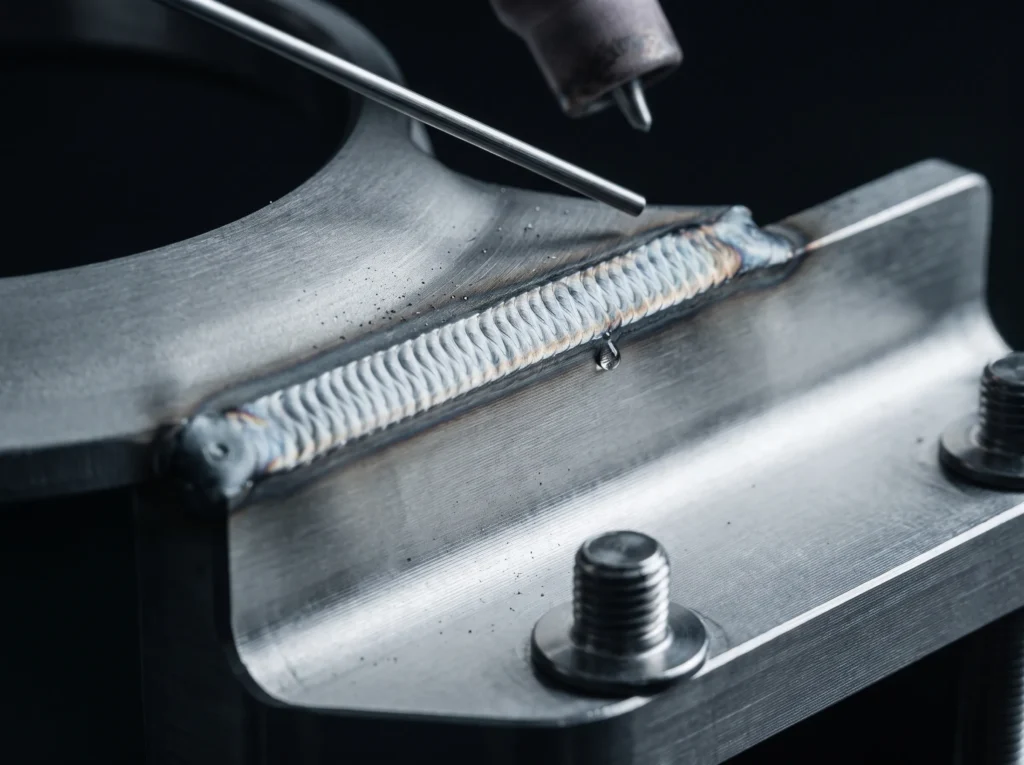
| Transition between two materials | Isolating bushes in the bill of materials | A galvanic couple left to the installer |
| Requirement above the published rating | Coamings or doublers added to compensate | A watertightness claim the part cannot support |
| Flush architectural detail | Zero step detail against a proud flange | Surface cut away to hide the fitting |
| Part out of production | “Superseded by”, with a different bolt pattern | Sound structure modified for a near fit |
1. The geometry matches no catalogue size
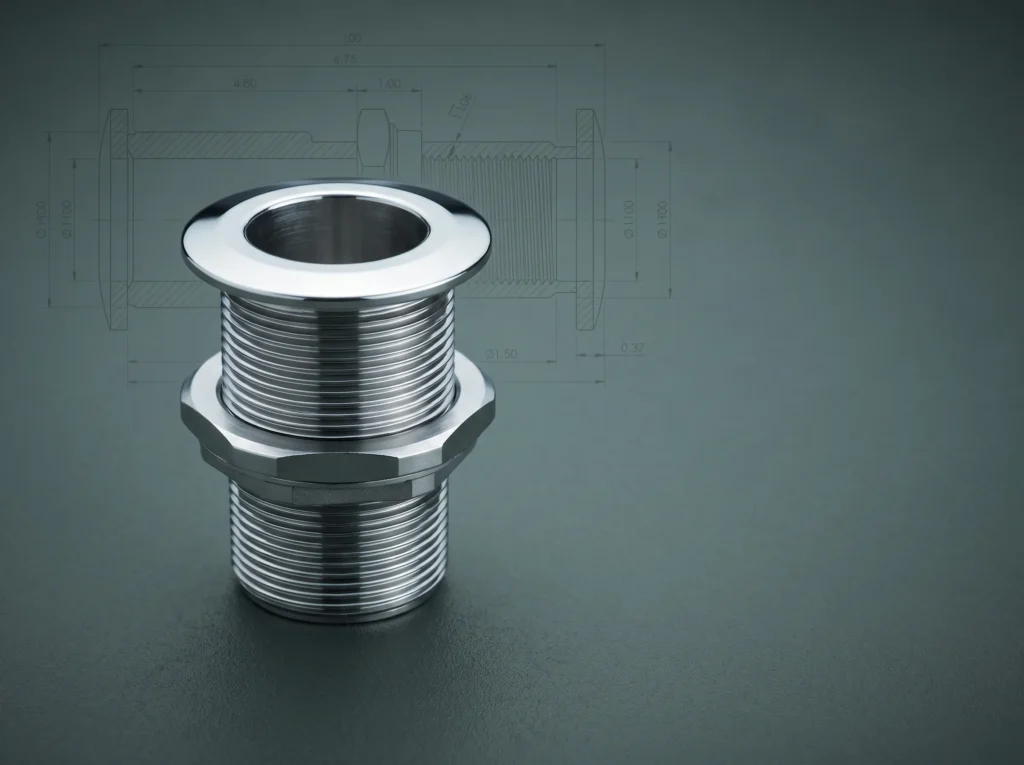
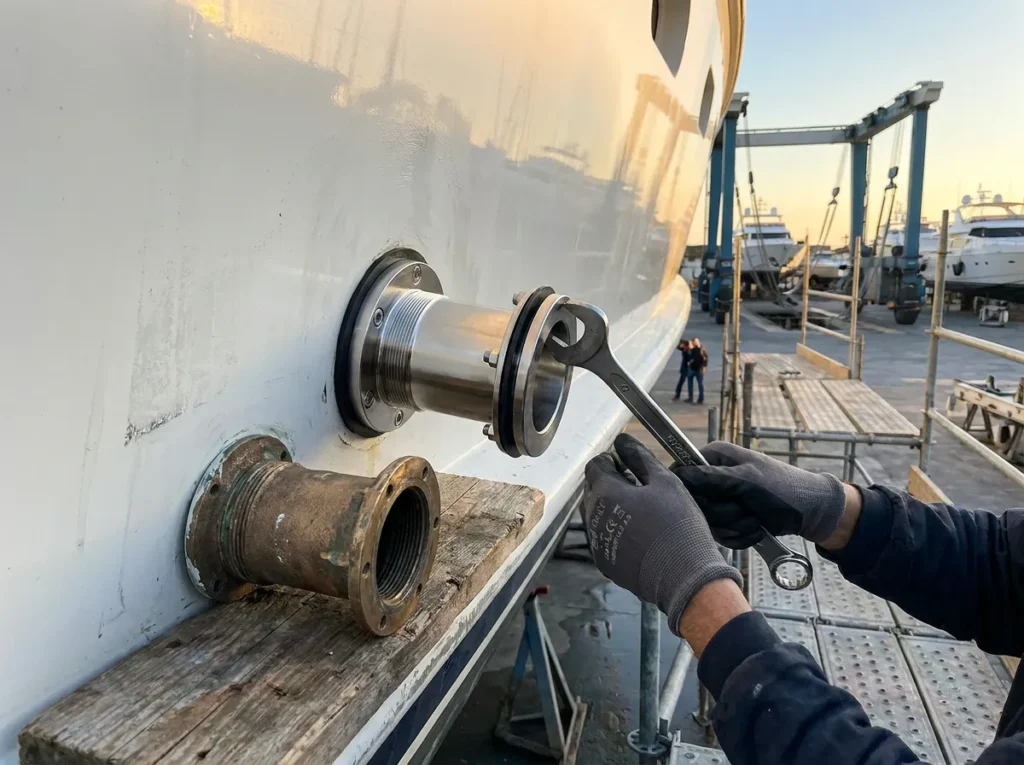
Catalogue fittings assume the mounting face their maker chose: flat, or a single curvature within a declared range. Hull plating around a through hull fitting or a scupper is often double curvature, and a flange drawn for a plane lands on three points of contact instead of a continuous face.
You recognise it when the installation detail starts growing parts from nobody’s catalogue: a packer, a wedge plate, a machined ring whose only purpose is to create somewhere flat.
The point of convenience has passed when that adapter acquires its own drawing, material specification and sealing face. A custom part has then been commissioned anyway, with two interfaces to seal instead of one.
2. The component crosses the interface between two materials
A fitting that passes from an aluminium 5083 structure into a stainless assembly, or from a composite deck into a metal frame, sits on a boundary catalogue hardware does not address. Standard components are conceived inside one material family, where fastening pattern, thermal expansion and corrosion strategy assume a single substrate. Aluminium and AISI 316 sit at different positions on the galvanic series, and a bolted joint between them in salt water is a textbook site for crevice corrosion.
You recognise it when the bill of materials for one fitting lists isolating bushes and washers, and a sealant is expected to carry load.
The signal is the design office specifying the isolation detail instead of the fitting. A machined body or a welded sleeve in a compatible alloy puts the material transition where it is controlled, not in a bolted sandwich assembled on board.
3. The requirement exceeds what the standard part was dimensioned for
Catalogue hatches, scuppers and through hull fittings are dimensioned against a declared envelope: a design pressure, an assumed position relative to the waterline and, often, a reference standard such as ISO 12216 for windows, hatches and doors, ISO 9093 for seacocks and through hull fittings, or ISO 11812 for watertight recesses. A requirement outside that envelope is not a grey area. It is a different part.
You recognise it when the published rating has to be interpreted rather than read, because the position on board is not the one it assumed.
The signal is structure added to compensate for the fitting itself: a raised coaming, a higher sill, a local doubler. The design has then declared the component insufficient. How watertightness is graded, how gasket compression set behaves over time and how a hatch is chosen against a required grade belong to the watertight integrity cluster; the two pieces under Related reading continue from here.
4. The component has to disappear into a design surface
A flush detail is a dimensional requirement, not a stylistic preference. Where the drawing shows continuous teak or an unbroken painted surface, the fitting must finish in the same plane as its surroundings, with a reveal set by the joinery rather than by the supplier’s tooling. Standard components bring their own rebate and flange thickness, and they stay visible even when well installed.
You recognise it when a zero step detail on one drawing meets a proud flange on another and nobody has reconciled the two.
The signal is the detail being resolved by cutting into the surrounding surface to conceal a part designed to protrude, which weakens that surface and moves the tolerance stack onto the weakest element. Eirion, a flush deck step and access hatch machined to sit in the plane of the deck, exists because this case cannot be solved downstream.
5. The part no longer exists and the boat still does
In refit, obsolescence is a technical constraint like any other. The original is out of production, the current equivalent differs in footprint or bolt pattern, and the choice is between modifying the vessel and reproducing the part.
You recognise it the moment a supplier answers “superseded by” and the replacement differs in the dimensions that touch structure.
The signal that custom has become the conservative option is when fitting the modern equivalent would mean enlarging an aperture, drilling a new pattern into sound structure or replacing a sound backing plate. Remaking the part keeps the modification inside the part and restores traceability: a newly machined component can carry an EN 10204 3.1 inspection certificate, which a discontinued fitting cannot.
Where the cost actually sits
The purchase price of a catalogue fitting is low and visible. The cost of making it work is neither, and it arrives later: fitting labour, adaptation components, rework when the installed result is rejected, and time at survey explaining an assembly no single document describes.
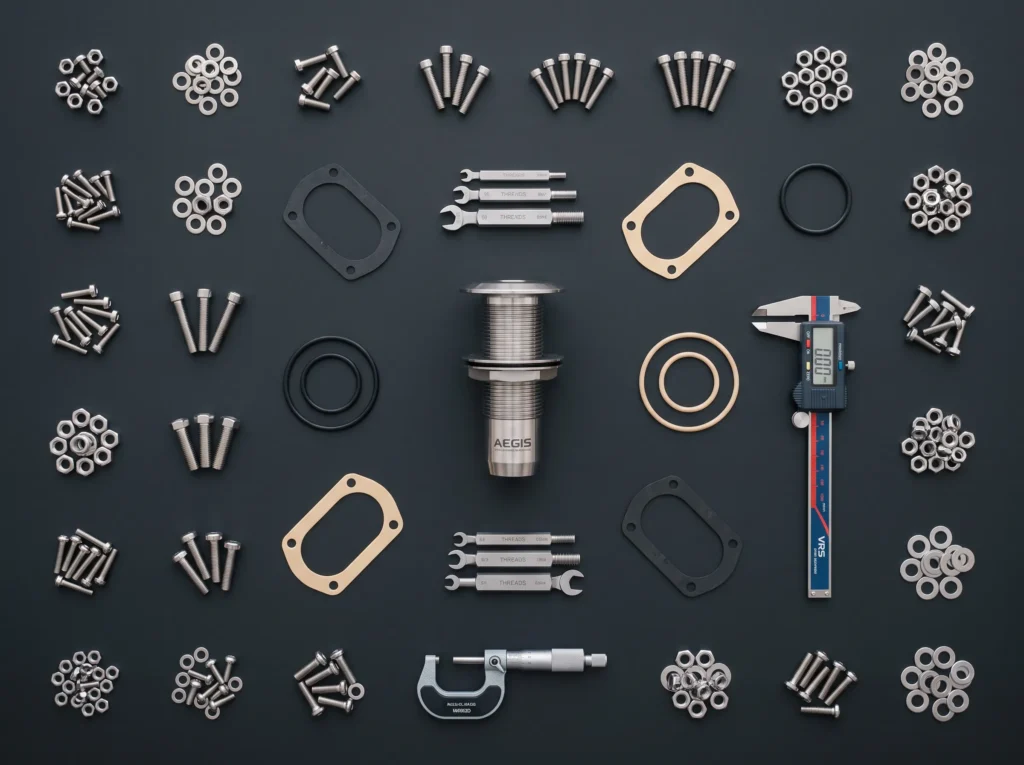
A bespoke component inverts the profile: cost is concentrated at the start, in engineering, drawing approval and setup, then falls away because the part arrives with its interfaces defined. What moves that initial cost is not prestige but four variables: the number of units, the tolerance required, the finish, and the documentation required. Comparing one unit against one price is misleading; the honest comparison is between two totals, each including the work after delivery.
When standard hardware is still the right choice
None of this argues for bespoke by default. The catalogue item is the correct answer whenever four conditions hold together: the mounting face is flat and within the nominal range, one material family is involved on both sides of the joint, the published rating covers the position on board with margin, and the fitting is allowed to be visible. A custom part then buys nothing the drawing needed.
Make the decision once, early, with the detail drawings in front of you rather than with the component already on the pallet. If a detail sits on the line between the two routes, show the drawing to a manufacturer before the order is written: the answer is sometimes that the standard item is fine. To discuss a detail, or to request the catalogue of marine components machined in Viareggio, write to info@officinevrs.com.
Frequently asked questions
How do I know if I need a custom marine fitting?
Check where the problem goes after the adaptation. If a catalogue item only works with packers, isolating details or material cut from the surrounding surface, a purpose made part is the simpler route.
Can a standard through hull fitting be modified instead?
Sometimes, but modification changes the conditions under which the component was rated and documented, and moves responsibility to whoever performed it. Where it touches the sealing face or the wall thickness, designing the part is more defensible.
Do custom marine parts come with material certification?
They can. Alloys such as AISI 316, 316L and aluminium 5083 are normally supplied against an EN 10204 3.1 inspection certificate, requested at order stage.
What does a manufacturer need in order to quote a bespoke component?
The mating geometry, the material and finish, the position on board, the load or sealing duty expected, and the documentation required. A dimensioned detail of the interface is often enough to start.