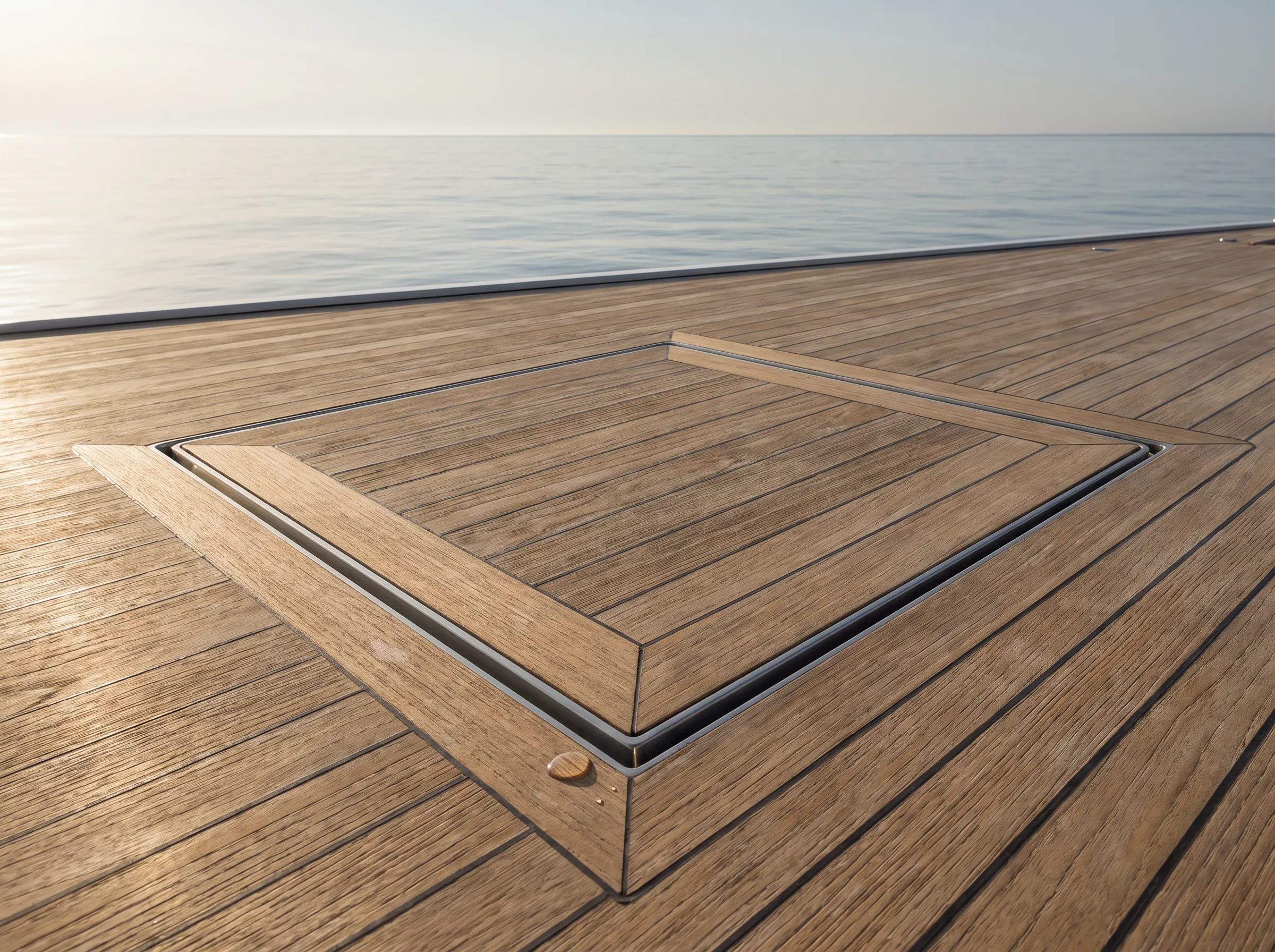
Watertight integrity on a yacht is the ability of the whole hull-and-deck envelope to keep water out under the pressure, motion and impact the vessel meets at sea — a property of the system, not of any single fitting. Water gets in through three families of openings: deck apertures, hull penetrations, and the drainage lines meant to carry water away. It almost never gets in through solid plate, casting or laminate; it gets in at the joint, where two geometries, two metallurgies or two materials are asked to behave as one. This article maps the domain and points to the detail that sits underneath it.
In short
- Watertight integrity is a system property: a yacht is only as tight as the weakest of its deck openings, hull penetrations and drains.
- Water enters three ways: an opening that should have been closed, a penetration that should have been sealed, or a drain running backwards.
- Seals fail at joints — welds, threads, flange faces, gasket lines — rather than in unbroken material.
- Crevice corrosion dominates at sealing points: AISI 316 needs oxygen to hold its passive film, and a stagnant, chloride-rich gap denies it.
- Static sealing is governed by gasket contact; dynamic sealing against boarding seas is governed by frame stiffness.
- Drainage belongs to watertight integrity, because an undersized or obstructed scupper loads every opening around it.
- ISO 12216 sets strength and watertightness requirements for hatches, portlights, windows and doors, and belongs in a specification by name.
The three ways water gets into a yacht
Every ingress path belongs to one of three families, each failing differently.
Deck apertures — hatches, access hatches, flush deck panels, portlights, doors — are designed to open, so tightness depends on a closure mechanism and a compressed elastomer, both consumable.
Hull penetrations — through hull fittings, sea inlets and discharges, exhaust outlets, transducers, shaft and rudder passages — are not. Their tightness depends on the continuity of the joint with the shell and on the pairing with the valve behind it.
Drainage lines — scuppers, cockpit drains, chain locker drains, bilge and grey water discharges — exist to move water, which is why they are the most often forgotten. A drain that fails admits water the vessel has already collected.
| Entry family | Failure mode | Component at the failure point |
|---|---|---|
| Deck apertures | Gasket compression set; frame distortion; contact lost along part of the perimeter | Frame, gasket, dogging hardware |
| Hull penetrations | Crevice corrosion at weld or thread; loss of preload; galvanic coupling to the hull alloy | Fitting, seacock, flange |
| Drainage lines | Obstruction; hose embrittlement and clamp relaxation; siphoning from a low outlet | Scupper, drain line, outlet |
Static and dynamic watertightness are two different problems
Static watertightness is standing water at low head: rain on a closed hatch, a flooded cockpit sole before it drains, condensation in a locker. It is governed by continuous contact between gasket and sealing face.
Dynamic watertightness is moving water: boarding seas on a foredeck, spray driven at speed, green water slamming a coachroof. The load is an impulse and the governing variable becomes structural stiffness, because a frame that deflects under impact opens a momentary gap along its longest unsupported span, faster than any gasket can follow.
Below the waterline a third condition applies: permanent hydrostatic head. Pressure rises with depth of installation and again with the vessel’s way through the water, so the deeper the fitting the less the joint can rely on a bedding compound. Depth is a design input, not an installation detail.
Why watertight integrity fails at the joint
Solid material is homogeneous; a joint is not. Every joining operation introduces at least one of three discontinuities.
Metallurgical discontinuity
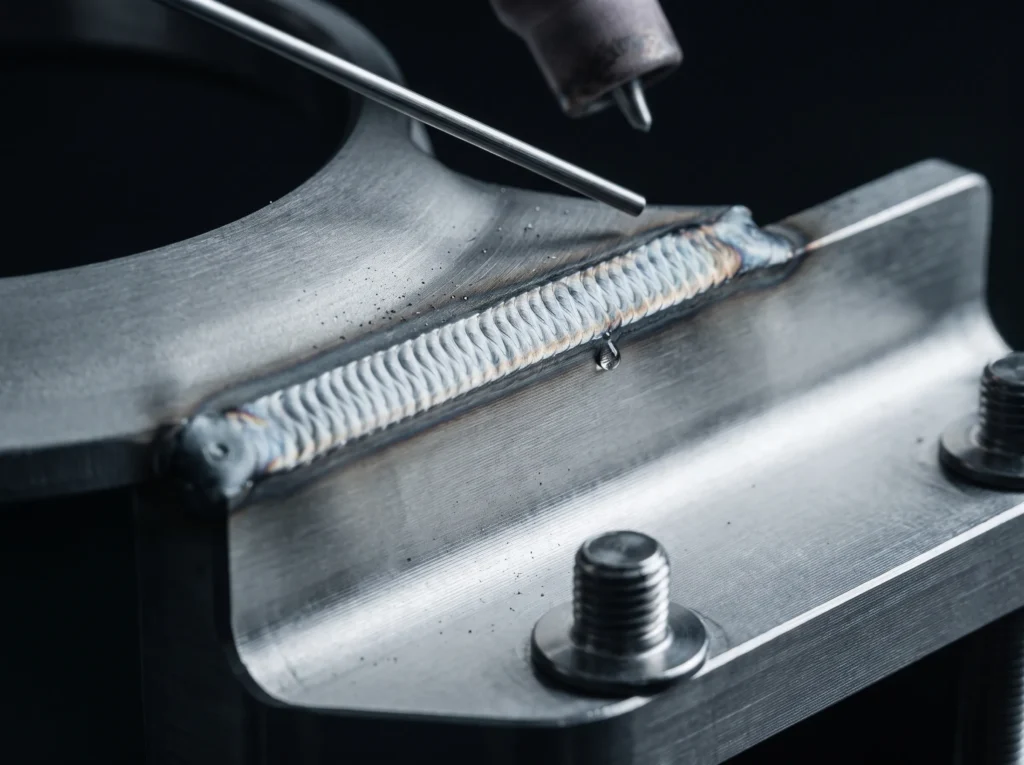
Welding creates a heat-affected zone with an altered microstructure. In austenitic stainless steels, time in the sensitisation range allows chromium carbides to precipitate at grain boundaries, depleting the chromium the passive film depends on; low-carbon grades such as AISI 316L exist to limit this. Welds also carry residual stress, and residual tensile stress in a chloride environment is a classic precondition for stress corrosion cracking.
Geometric discontinuity
Threads, flange faces, washers and gasket lines create tight gaps. In a gap filled with seawater, oxygen is consumed faster than it is replenished, chlorides concentrate and local pH falls. The passive film cannot regenerate and crevice corrosion begins, attacking by definition the places intended to seal.
Material discontinuity
Two dissimilar metals in electrical contact within one electrolyte form a galvanic couple, and the less noble corrodes: a stainless fitting bolted into 5083 aluminium without isolation, with the aluminium anodic.
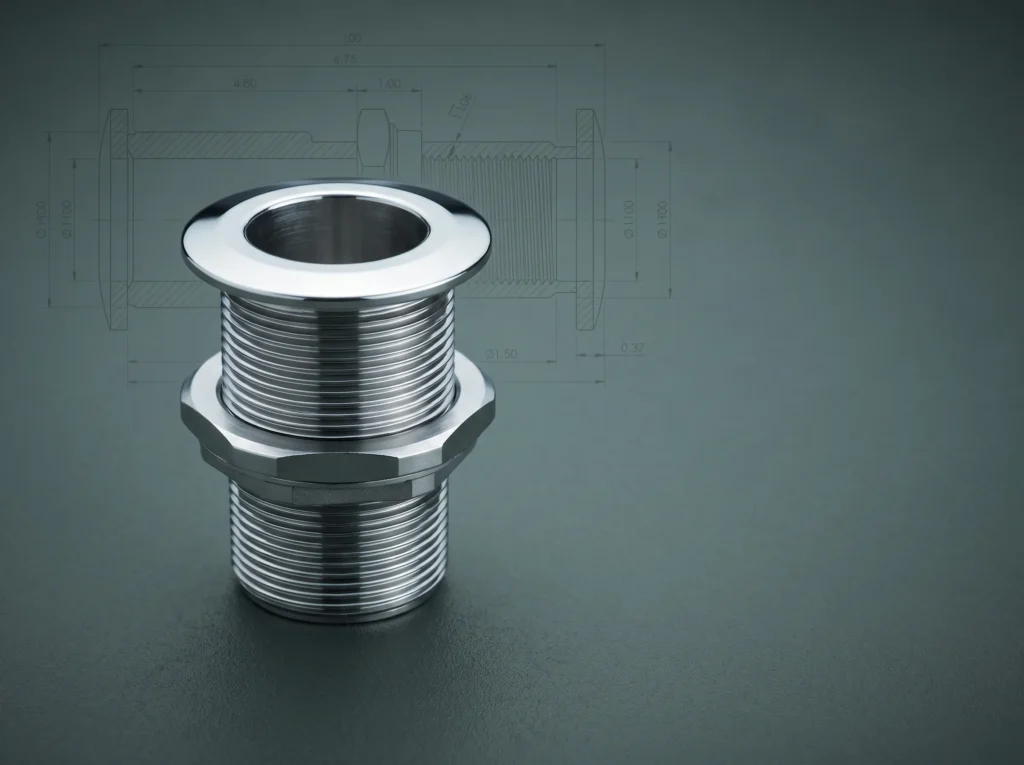
The design response is to reduce the number of joints rather than seal each better. Aegis, the through hull fitting machined from a single billet without welds, applies that principle: no bead, no heat-affected zone, no root crevice.
| Joining strategy | Continuity breaks at | Corrosion risk | Maintenance |
|---|---|---|---|
| Machined from solid | The designed interfaces only | No heat-affected zone, no root crevice | Gasket and preload |
| Welded | Every bead, root and heat-affected zone | Sensitisation, root crevices, residual stress | Weld inspection; repair in place |
| Assembled from parts | Every mating face and thread | A crevice under each face and thread | Re-torque and gasket schedule |
Drainage: getting water off the deck before it looks for a way in
Standing water is the load case every deck opening is measured against. A deck that drains quickly reduces the head on every hatch, coaming and joint around it.
Scupper sizing follows the catchment area feeding the outlet, the acceptable depth of standing water, the number of outlets, the length and bend count of the path, and heel and trim — an outlet clear of the water at rest may be immersed under heel. ISO 11812 addresses watertight and quick-draining cockpits specifically.
Section geometry follows the structure the drain must cross. Nereus, the oval scupper, exists because a bulwark or covering board often offers limited thickness in one direction: an oval section preserves flow area where a round section of equal area would not fit.
Two routing decisions dominate reliability. The first is eliminating rubber hose from discharge lines, because hose hardens, chafes and takes a permanent set at bends while its clamps lose preload. The second is outlet height relative to the waterline, since an outlet close to or below it can siphon inboard. Obstruction prevention — smooth transitions, generous radii, no abrupt change of section — is solved on the drawing.
Hull penetrations and the valve behind them
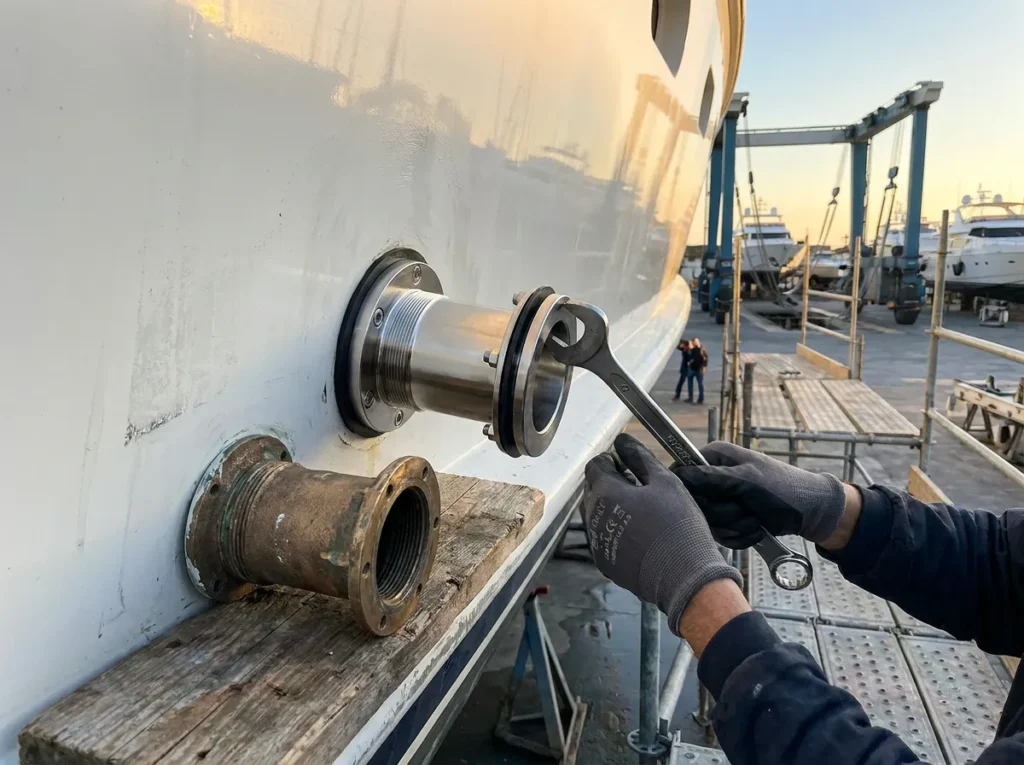
A through hull fitting is half an assembly, designed together with its valve and the hull it crosses. Thread form and flange geometry must match the valve, because a thread engaging on partial depth is both a leak path and a strength deficit. ISO 9093 is the reference standard for seacocks and through-hull fittings on small craft.
In a metal hull the fitting is welded into the shell, so the penetration becomes a welded joint in a structural plate and inherits everything that applies to shell welds, including isolation where fitting and plating alloys differ. In a composite hull the laminate is compressible and creeps under sustained load: the seal forms between flange face, bedding compound and gelcoat, with a backing pad spreading the load. Over-tightening crushes the laminate and relaxes the joint, which is why clamping load on GRP is a specified value, not an installer’s judgement.
Openings: matching the grade of seal to the zone
Specifying the highest grade everywhere buys weight and complexity the zone does not need. An exposed weather deck is governed by frame stiffness, low profile and multi-point closure; a cockpit sole by a flush, non-slip, load-bearing closure; topsides above the waterline by drainage and surface continuity; a penetration below the waterline by joint continuity and valve pairing, where the valve rather than the sealant closes; and a watertight bulkhead by the grade the bulkhead itself is rated to.
Sizing follows real use, not catalogue convention: an access hatch is sized for the largest object that must pass in service, because an undersized opening is enlarged at the first refit, when the surrounding structure is already built.
Perimeter drainage is the second line of defence. A channel that collects whatever passes the primary gasket and takes it overboard turns a leak into a nuisance, and it is what makes flush installations viable.
Gaskets, clamping load and the life of a seal
A gasket seals because it is held in its elastic range. Too little compression gives discontinuous contact along the perimeter; too much gives permanent set, after which it no longer recovers. Good designs include a hard stop that fixes compression geometrically, so the seal does not depend on how hard the last person turned the handle.
Material follows chemistry. EPDM performs well against water, ozone and UV and poorly against mineral oils; nitrile is the reverse; silicone tolerates a wide temperature range with lower tear strength; fluoroelastomers are chosen for fuel and chemical exposure.
Clamping devices distribute load. A single central latch on a long opening loads the gasket at one point and leaves the corners free, so dogging points follow the frame’s deflection pattern rather than appearance. Aetos, the watertight hatch, is an instance of that reasoning: closure hardware and frame are dimensioned as one structure.
Verifying and specifying watertight integrity on a yacht
Verification happens in the yard, on the assembled vessel, and costs a fraction of finding the same defect afloat. The usual sequence is a witness check that the gasket leaves a continuous impression around the full perimeter, a hose test on the closed opening from the exposed side, and — where the arrangement allows — a flood or pressure test of the compartment behind it. Class societies such as RINA, Lloyd’s Register, ABS and DNV each publish their own survey schemes.
A specification that protects the yard names, for every opening and penetration: the alloy and material certificate required, EN 10204 3.1 being the common reference; the joining strategy, stated as machined from solid, welded or assembled; sealing face geometry and finish; gasket material and how its compression is limited; fastener preload; isolation between dissimilar alloys; drainage path and flow section; and the test method and acceptance criterion. ISO 12216 covers strength and watertightness requirements for openings, and Directive 2013/53/EU is the European framework for recreational craft compliance.
This is the everyday vocabulary of the Viareggio yards and the Italian superyacht supply chain, where hardware of this kind is machined and hand-finished.
Frequently asked questions
What does watertight integrity mean on a yacht?
It is the ability of the complete hull and deck envelope to prevent ingress under the pressure, impact and motion met in service. It is assessed as a system: one deficient opening, penetration or drain defeats the rest.
Where does water actually get into a boat?
Through deck apertures such as hatches and portlights, hull penetrations such as through hull fittings and sea inlets, and drainage lines that back up or siphon. The leak almost always starts at a joint.
Is a through hull fitting better machined from solid or welded?
A fitting machined from a single billet has no heat-affected zone, no weld-root crevice and no weld residual stress, removing three common corrosion initiation sites. A welded fitting adds a discontinuity that must be inspected and repaired in place.
How are deck scuppers sized?
Sizing follows the catchment area draining to the outlet, the acceptable depth of standing water, the number of outlets, the length and bend count of the path, and heel and trim. There is no single correct diameter.
Why remove rubber hose from drain and discharge lines?
Hose hardens with age and UV, chafes where it passes structure and takes a permanent set at bends, while its clamps lose preload. A continuous rigid line removes both as failure items.
What is crevice corrosion and why does it attack seals?
It occurs in a narrow gap where seawater stagnates, oxygen is depleted, chlorides concentrate and local pH falls, so the passive film on AISI 316 cannot regenerate. Sealing points are full of such gaps by construction.
What does ISO 12216 cover?
It sets strength and watertightness requirements for windows, portlights, hatches, deadlights and doors on small craft, relating required performance to the area where the opening is fitted. Naming it fixes both the test and the pass criterion.
How is watertightness tested in the yard?
A witness check for a continuous gasket impression, a hose test on the closed opening from the exposed side, and where the arrangement permits a flood or pressure test of the compartment behind it. A vessel under class survey follows its society’s scheme.